Dachau was initially a camp for political and ideological opponents of the Nazi regime, e.g., union leaders, communists, and social democrats. Jews who were members of these groups were detained, but mass arrests of Jews did not take place until Kristallnacht, five and a half years later.
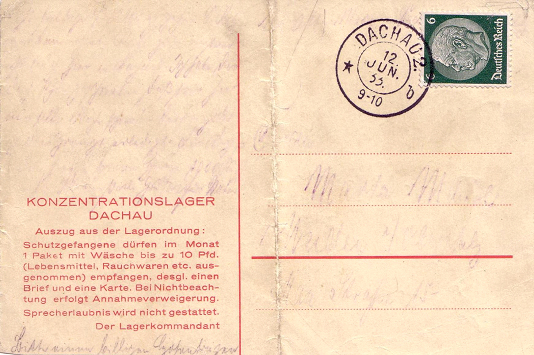
This image is the full post card. The preprinted instructions indicate that

Protective prisoners may receive 1 package of underwear every month up to 10 lbs. (food, smoking materials, etc., are excluded). In addition, one letter and one postcard are permitted. Nonobservance of the rules will result in confiscation. Visitation is not permitted.

The writer, Otto Marx, was a merchant in Bavaria. He later wrote a book about his experiences in Dachau.
Anti-Semitism

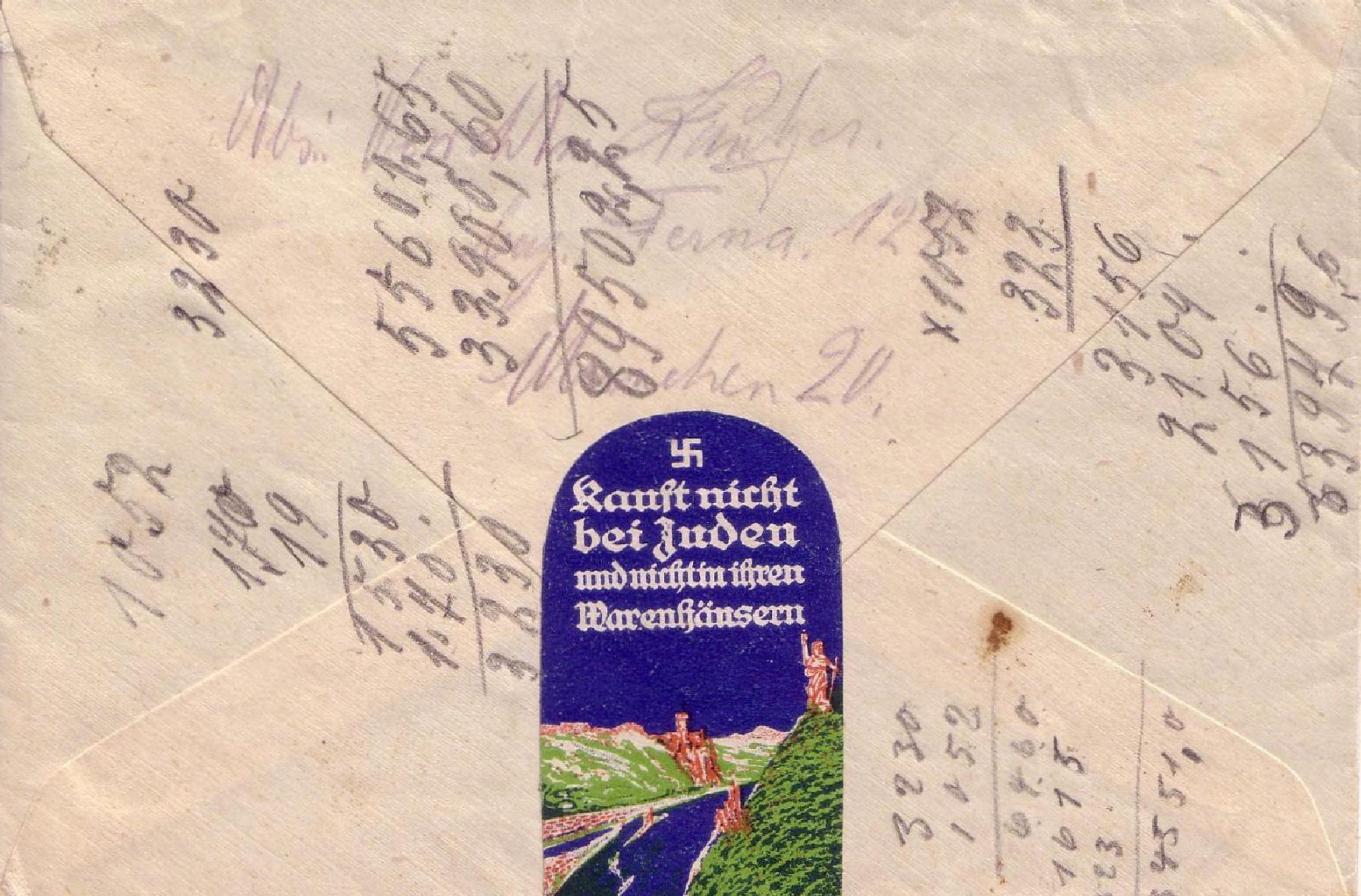
Hitler’s rise to power began with the fall of the Weimar Republic. There was rampant unemployment and great unrest in Germany. Hitler made speeches at beer halls, union party gatherings, and other events. One of his major themes was that Jews were the root of all evil and the cause of Germany’s problems. Anti-Semitism began to raise its ugly head and was manifested in many different forms: anti-Semitic literature, songs, and even labels placed on envelopes.

The back of this envelope, postmarked in the mid-1920s, bears an anti-Semitic label reading “Don’t buy from Jews or shop at their stores.”

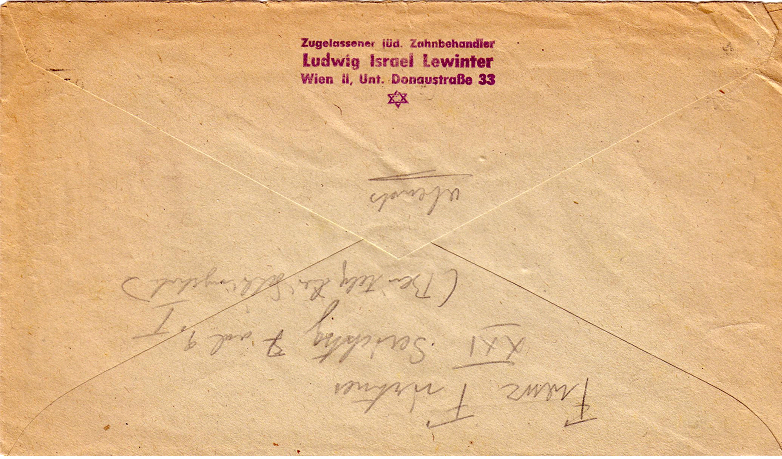
Ludwig “Israel” Lewinter was a dentist practicing in Vienna. However, due to the changes in laws, his practice was limited to Jews and his title was no longer dentist: it was “caretaker of Jewish teeth” (Zahnbehandler).

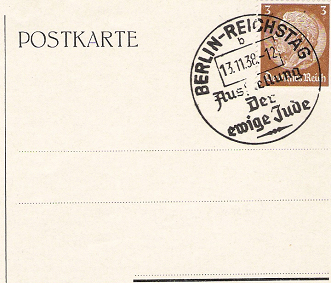
A very popular collecting area for stamp collectors is souvenir cancels, which commemorate an event. For many events, the postal authorities create a special cancel just for that event. Collectors will have a cover cancelled for their own collection or to send to other collectors. The following is an example of a souvenir cancel from Der ewige Jude.

This souvenir cancel, from when the exhibition was in Berlin, is dated November 13, 1938. In this case the collector had the stamp cancelled and placed the cover in his collection, rather than sending it through the mail.

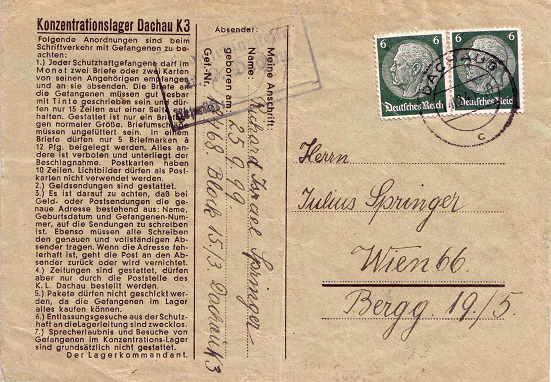
It is very unusual to see mail from Jewish inmates in the concentration camps; they were seldom accorded the privilege to write letters. We can identify these inmates and their mail by the Sara and Israel middle names.

This cover from Dachau contains the Israel middle name: Richard “Israel” Springer. The letter is dated February 4, 1940. The preprinted instructions inform the sender of what can be sent to the inmate.

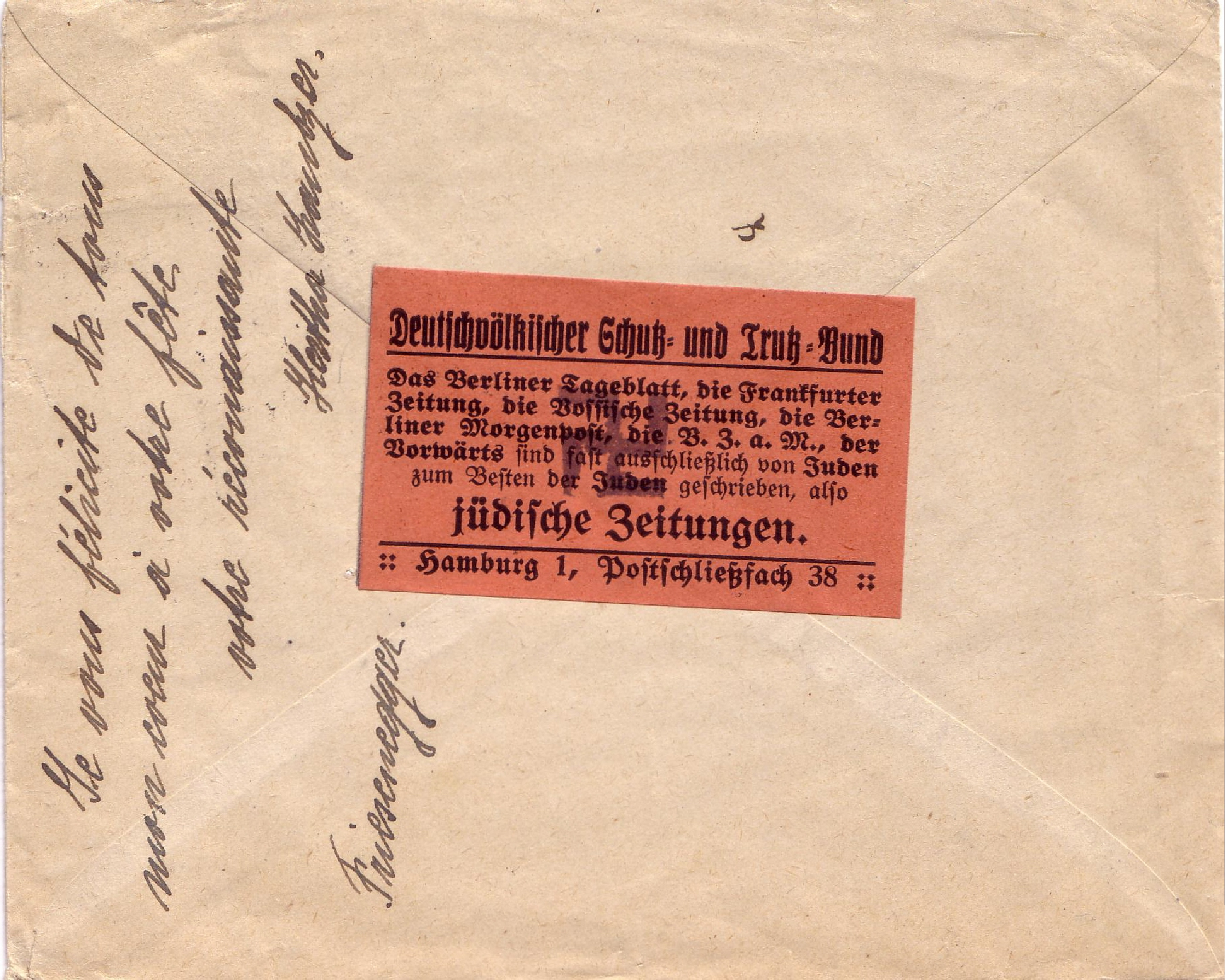
This letter, also postmarked in the mid-1920s, is another example of a label containing anti-Semitic propaganda. The label reads

The Berliner Tageblatt, the Frankfurter Zeitung, the Vossische Zeitung, the Berliner Zeitung am Morgen, the Vorwärts, are all almost exclusively written by Jews for Jews, and are thus Jewish newspapers.

An interesting observation: The backwards swastika appeared here before it was formalized as the logo for the Nazi party.


Next

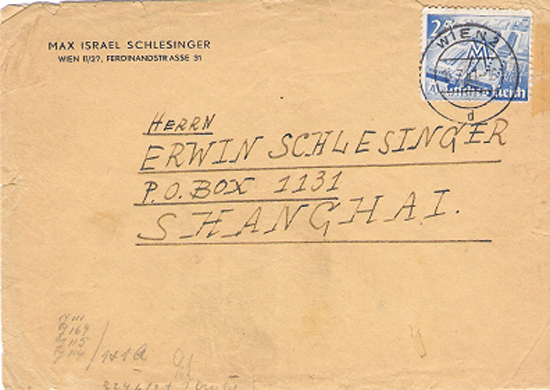
This cover contains an example of the Israel middle name: Max “Israel” Schlesinger. This letter was sent from Vienna to Shanghai, China, on July 11, 1941.

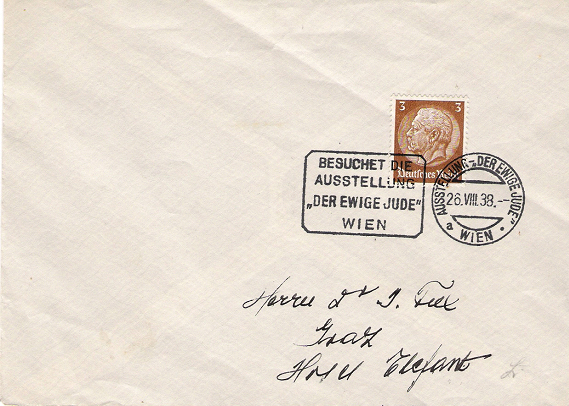
This cover was addressed to a collector and has a souvenir cancel dated August 26, 1938, when the exhibit was housed in Vienna, Austria.


Back Next

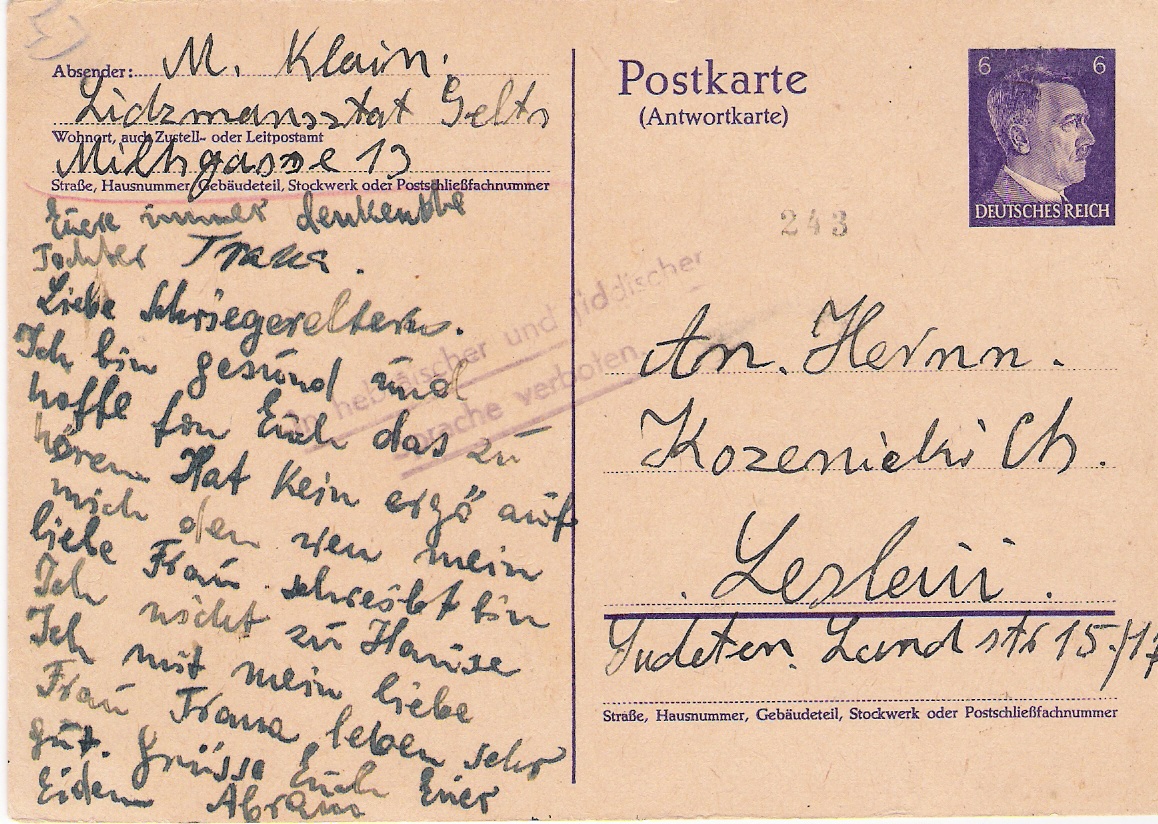
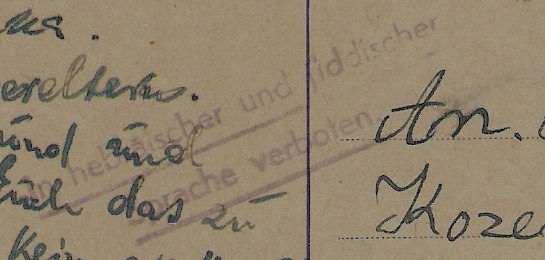
This postal card was returned to the sender with a stamp indicating that the card should not be written in Hebrew or Yiddish, but only German.


Back Next

Family Camp

At Auschwitz 2, or Birkenau, several distinctive camps were established. The family camp established by the Nazis was modeled after the Theresienstadt ghetto. It was supposed to be a model camp where the International Red Cross would visit and the see how well the Jews were treated under the Nazis. This never came to fruition.

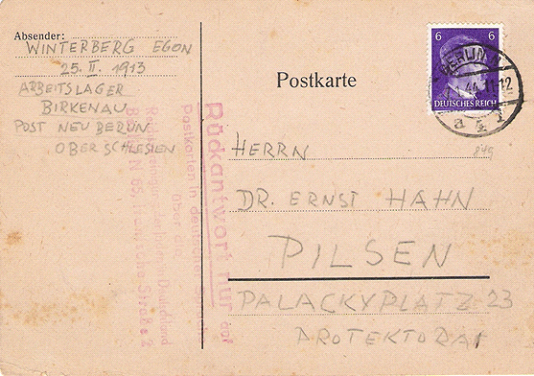
On September 8, 1943, the first residents of the Family Camps were transported to Auschwitz: 5000 Czechoslovakian Jews. They set up a model town with schools, a government, and postal system. The Nazis asked them to write post cards to their friends and relatives on March 9, 1944. The next day all the people in the family camp were gassed. The Nazis kept sending out these cards months after those who wrote them were killed. The Nazis parlance called this a Brief Aktion. Brief means “letter” and Aktion by Nazi definition is the German word for an “action” or campaign. When used by the SS or Gestapo, it often meant the roundup or murder of Jews.

This postcard was sent to Pislen, Czechoslovakia, with the return address Arbeitslager Birkenau, where the family camp was located. It was distributed through the Jewish Association in Berlin.