Holocaust through letters and cards of the victims
The Ghetto Mail Man: Warsaw Ghetto
The letter carrier’s lot is an unhappy one. He rises at five in the morning and works till nine, ten in the evening and in spite of that, he receives no weekly wage, but gets paid by the piece—six groszy per letter, and after subtracting all taxes and contributions to “social insurance” from which he, as a Jew, cannot benefit according to the canons of the occupation authorities, but for which he enjoys the privilege of paying, there hardly remains five groszy net. The delivery of one hundred, even one hundred and fifty letters a day nets him a ridiculous sum, when a loaf of black bread costs between 22 and 24 groszy ….
This is the life of a ghetto postman in the Warsaw ghetto during the Holocaust. This was penned by Perez Opacynziki, a talented Yiddish writer, in an essay “The Ghetto Post Man” for the Oneg Shabbat archives. He was a post man by need and a writer by profession. In this article, I use excerpts from his observations and combine them with what we know about the postal system of the ghetto. This provides unique insight into the ghetto postal system with commentary from within.
The Oneg Shabbat group was composed of writers, teachers, and observers who gathered every Friday night (thus the name Oneg Shabbat “Sabbath pleasure”) under the tutelage of historian Emmanuel Ringelbum, to record life and death in the ghetto for posterity. These observations, diaries, notes, and stories were gathered and placed in four milk cans and buried before the ghetto was destroyed. Three of the four milk cans were recovered after the war and now give us insight into life in the Warsaw ghetto.
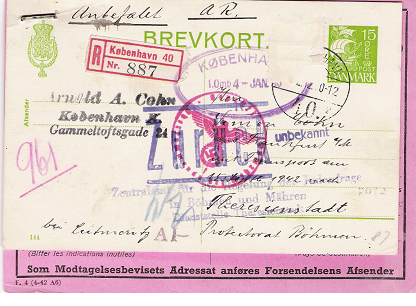
The cover in Figure 1 relates a very fascinating chapter in the Jewish involvement in World War II. It tells us of family separation, migration, involuntary transport, and and evidence of the Nazi “Final Solution.”
Figure 1: Card sent from Copenhagen, Denmark, to Theresienstadt
Arnold Cohn, the sender of this card, came from the city of Hamburg and served in the German army during World War I, like many of his Jewish countrymen. Unlike many Jews who stayed when the Nazis came to power, he relocated to Denmark. This destination proved to be temporary, as Hitler’s conquest spread to all of Central Europe. When the Nazis invaded Denmark, he was forced to flee again, this time to Sweden.
Arnold’s brother Simon was not so lucky. He lived in Frankfurt and was involuntarily transported to Theresienstadt, a walled city that served a unique purpose, on Sept. 15, 1942. During 1942 the Nazis moved many thousands of German and Austrian Jews east to the Polish ghettos and also to Theresienstadt.
Theresienstadt was the “model ghetto” established by the Nazis to appease many different groups. The Nazis announced that all German Army veterans of World War I, government officials, and the elderly could buy apartments in Theresienstadt by signing over their property to the Nazis; of course those who did so received nothing. To the Jews of Bohemia and Moravia the Nazis announced that Theresienstadt was the city set aside for the Jews of the region to live and work.
Families arriving in Theresienstadt were kept together, and the ghetto was fixed up to serve as a model community to show off to the International Red Cross. Also, work was provided for many of the residents, giving the impression of a normal town. In actuality, Theresienstadt was just a temporary stopover on the way to Auschwitz and the other death camps of the east.
On September 8 and 9, 1939, the Nazi army invaded Poland, and within the month they occupied the country. This began Hitler’s attempted destruction of the Jewish people and the ultimate destruction of a unique way of life that existed in Eastern Europe. Within that first month of occupation, the Jews of Poland celebrated the first High Holy Days. They met on Rosh Hashanah and Yom Kippur with uncertainty and a maze of Nazi decrees.
Rabbi Shimon Huberband, who perished in Treblinka in August 1942, described this first Rosh Hashanah:
On the eve of Rosh Hashanah (Wednesday), a notice was issued that Jews were required to keep their shops and businesses open on the Shabbat and all Jewish holidays…On Rosh Hashanah 5700, close to 20 Jews gather in synagogue. The rabbi didn’t attend, the cantor didn’t lead the prayers, and the length of the service was shortened… Germans were proceeding from house to house… they took… all their possessions and dealt murderous blows. (p. 66)
This first celebration of Rosh Hashanah and Yom Kippur under the Nazis was not just difficult, it was deadly, and being Jewish under the Nazis would continue to prove dangerous and being observant, near impossible. Emanuel Ringelbum comments in his Oneg Shabbat journal about the Yom Tovim 1940:”A Jew who prayed poorly on Rosh Hashanah, when asked why, he replied the prayer matches the year (sic)…” (p. 66).
Auschwitz, the largest and most notorious concentration camps, was established by the Nazis during the Second World War. The name alone is synonymous with genocide and extermination. Located near the town of Oswiecim, Poland, it grew into a vast complex of 3 main camps and over 70 sub camps.
From the camp’s establishment in May 1940 to January 1945, when most surviving Auschwitz prisoners were marched off by their German captors and Soviet troops liberated the camp, approximately 405,000 prisoners of both sexes, from nearly every European country were registered, assigned serial numbers, and incarcerated there. Almost 1.5 million people lost their lives at the camp.
Auschwitz 1 was “primarily a concentration camp serving a penal function”: it housed political prisoners, Poles, homosexuals, and a few Jews. The forced labor camp of the Auschwitz complex, it held between 13 to 16 thousand prisoners at any one time. In barrack 10, doctors conducted pseudo-scientific research on infants, twins, and dwarfs, and performed forced sterilizations, castrations, and hypothermia experiments.
Auschwitz 2, or Birkenau, contained the gas chambers and the crematorium. From spring 1942 until fall 1944, the operation designated to annihilate European Jews functioned almost without ceasing as transport trains delivered Jews from Nazi-occupied countries. This is the camp where most of the Jews were sent. The camp held up to 100,000 prisoners at one time and had 4 gas chambers and a crematorium to dispose of the bodies. An estimated 1 million to 1.5 million Jews were sent to their death here.
Auschwitz 3, called Monowitz or Buna, was a forced-labor camp set up in the spring of 1942 for IG Farben Chemical Works which produced synthetic rubber and liquid fuel. They used slave labor, paying the Nazis for the use of these prisoners to produce their products.
Within Birkenau, the administrative offices operated and ran the camp. They were the heart of the camp administration, controlling all aspects of the camp and its functions. The offices were divided into 6 administrative divisions:
Briefaktion, which is German for “letter action,” or, as some philatelists refer to it, “operation mail,” was a Nazi ruse used a number of times throughout the history of the Reich. Aktion is a famous Nazi euphemism used to refer to any non-military campaign to further Nazi ideals of race, but most often the term referred to the assembly and deportation of Jews to concentration or death camps (see About.com, http://history1900s.about.com/od/holocaustglossary/g/Aktion.htm).
Nazi euphemisms and terminology were used throughout the history of the Reich for misdirection and to disguise the actual action intended. Arbeit Macht Frei, “Work makes you free,” was a sign placed over the entrance of Auschwitz: the work was, of course, was slave labor. Endlosung, or “Final Solution,” is the term used to define the elimination of all Jews. The word Briefaktion is no different; the ruse lies in the total misinformation conveyed by the letters, which always were sent after the writers had died or were on the way to their demise. The Briefaktionen were intended to lead people to believe that they should not be frightened about deportations, as they were merely transfer to a new place to work.
Examples of Briefaktionen
The most famous example of this type of deception was practiced in the Familienlager or “Family Camp” in the Birkenau section of Auschwitz. A unique document (Figure 1) from the Auschwitz Museum Archives shows an order for a truck to implement a Briefaktion des RSHA (Juden). It was for a truck and 2 persons to pick up mail at subcamps of Auschwitz 3 (Monowitz) and Camp Javisciovitz. The mail would be taken to Berlin, were it would be censored and post marked.
Figure 1: Document from the Auschwitz Camp Museum, requesting a mail pick up at Auschwitz 3 and Camp Javisciovitz. This mail was to be used for a Briefaktion.
There were other noted Briefaktionen that took place. In the summer of 1942, letters were received from victims of mass deportations of Jews from Warsaw to Treblinka. The Gestapo had their victims write that they were in the east, were in working and employed and that things were good. The letters were falsely postmarked from Smolensk or Bobruisk, and their writers were taken to the gas chambers.
Another example took place in Kielce, where boys were sent for forced labor to a munitions factory in Skarzysko-Kamienna. They wrote to their relatives that they were in good health, had sufficient food, and were with their families (Yad Vashem Studies: 1967, Volume VI, 70).
Briefaktion LinkingTheresienstadt and Auschwitz
The family camp concept began within the Theresienstadt ghetto outside of Prague, Czechoslovakia. Theresienstadt was originally built as a fortress for Austrian royalty under the orders from Joseph II of Austria in 1780 to 1790 and was named for his mother, Maria Theresa, who ruled from 1740-1780. The Nazis took control on June 10, 1940 and turned the little fortress, the Kleine Festung, into a prison (see note below for an observation about the postal system). By November, 1941, the bigger fortress had become a ghetto.
The Nazis intended Theresienstadt be a model ghetto, a working town that would demonstrate how well the Jews d under Nazi rule. It had stores, factories, schools, musical productions, and a “government” that functioned under the Nazis oversight. The only thing that changed were the people. Jews were constantly being shipped into Theresienstadt and transported out to Auschwitz. The population was gathered mostly from the “Protectorate”: Germany and other western European countries. They were particularly prominent persons, old people, or those who had served in the German Army during World War I.
Auschwitz is one of the most notorious concentration camps established by the Nazis during the Second World War. The name alone is synonymous with genocide and extermination.1 At no other place in the Nazi sphere of power were so many people killed as in Auschwitz. But it was by no means the center of the genocide of European Jews.2 The Nazis invaded Poland on September 1, 1939, and within a month they had completely occupied the country. Within six months of the occupation, they erected Auschwitz, the flagship of concentration camps.
Auschwitz was located in Zasole3, a suburb of Oswiecim, a small Galician town in Upper Silesia. It had about 12,000 inhabitants, about half of whom were Jewish. Construction on the camp began early in May 1940, using existing Imperial Austrian artillery barracks, a collection of about twenty dark and dinghy single-story brick buildings. The town was evacuated and the homes demolished to pave the way for the camp. On May 20, 1940, Auschwitz opened with 30 German prisoners transferred from Sachsenhausen, a camp located in the Reich itself. They received the first 30 numbers assigned to prisoners.(( Website: Holocaust History. Holocaust Resources. Holocaust Remembrance .)) These 30 technically skilled German prisoners assisted in erecting the camp.
The first transport to Auschwitz, from the Polish city of Tarnow, contained 728 young Polish dissidents, 20 of whom happened to be Jews. They arrived on June 14, 1940, and were assigned numbers 31 to 758. This first transport contained many young Poles who tried to get to France to join the Polish Army in Exile.((Website: The first transport to Auschwitz-Tarnow, June, 1940:Wiadomosci24.pl (Polish News story) June 10, 2010.)) Out of these first 728 prisoners transported to Auschwitz, 298 survived the war and 272 did not survive; the fate of the remaining 158 is unknown.4)
The first transport of non-Poles contained 60 Czech citizens and arrived on June 6, 1941. They were from Brunn, Czechoslovakia, and were assigned numbers 17045 to 17104.
The first transport of Jews was on February 15, 1942. They were from Bytom, (Beuthen) in German-annexed Upper Silesia. They were not assigned numbers, as they were gassed on arrival.