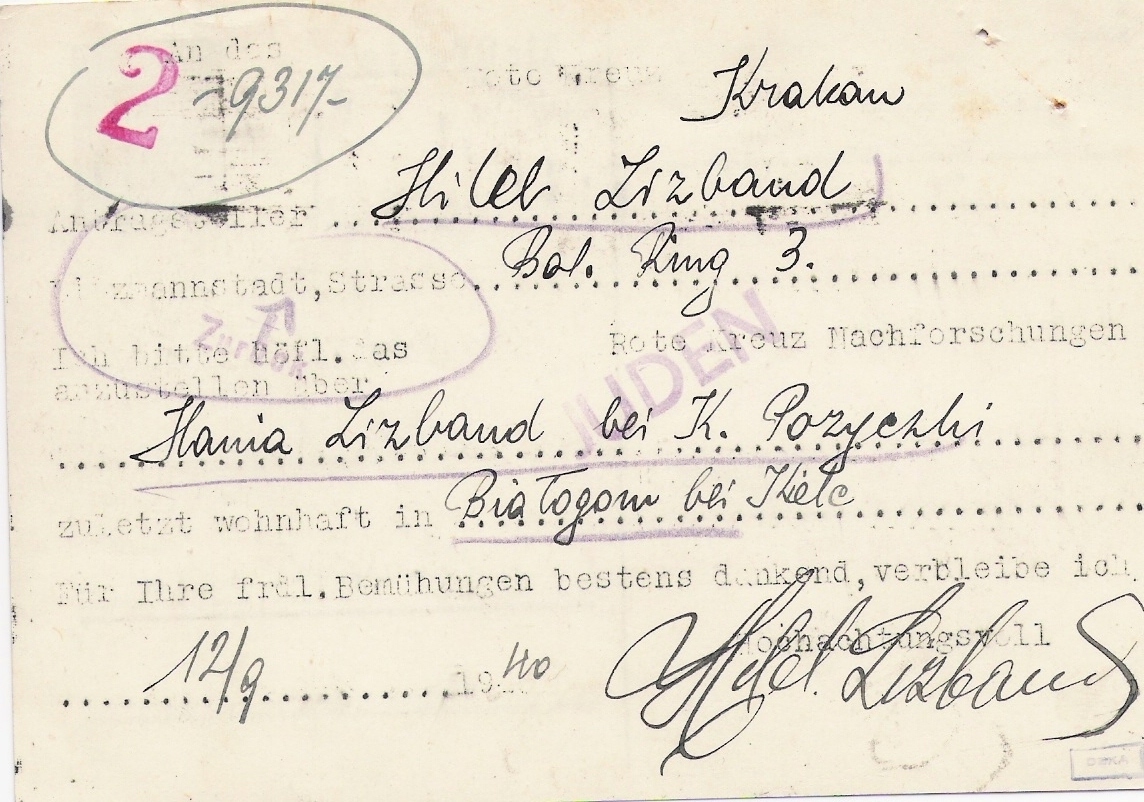
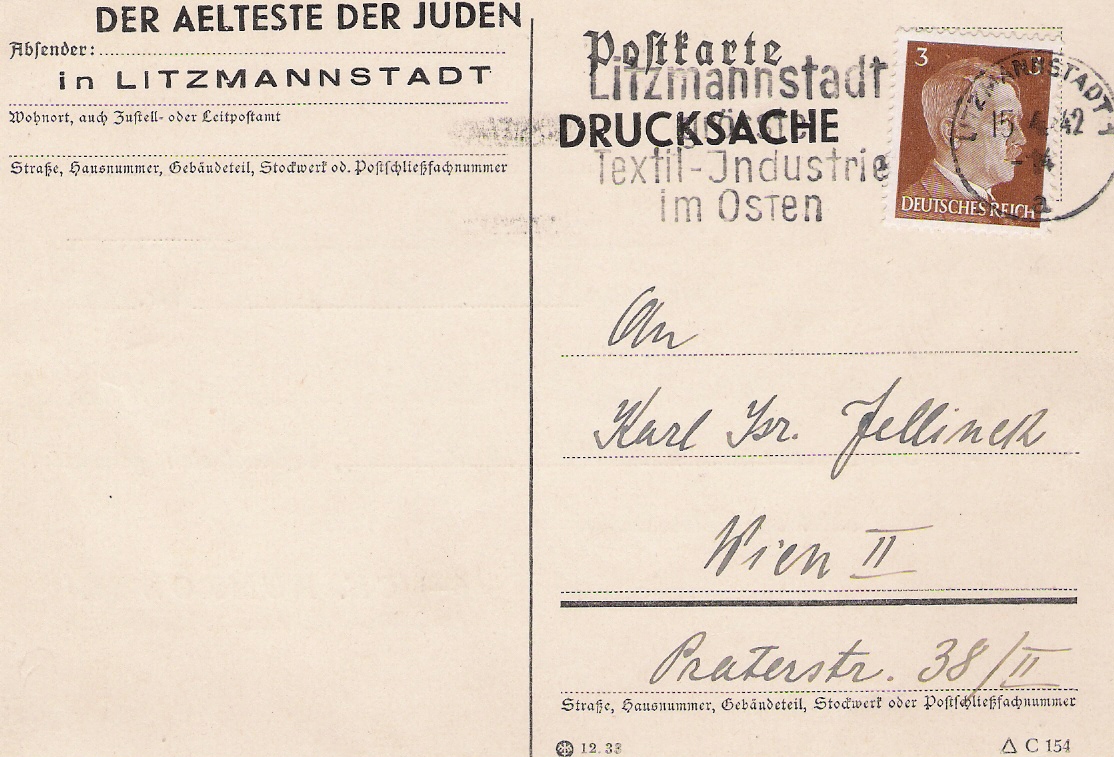
This postcard, sent from Litzmanstadt, has a circular April 15, 1942, cancel and a return address from the Aelteste der Juden in Litzmannstadt. It was addressed to a Jewish individual in Vienna, Austria, who uses the “Israel” middle name.
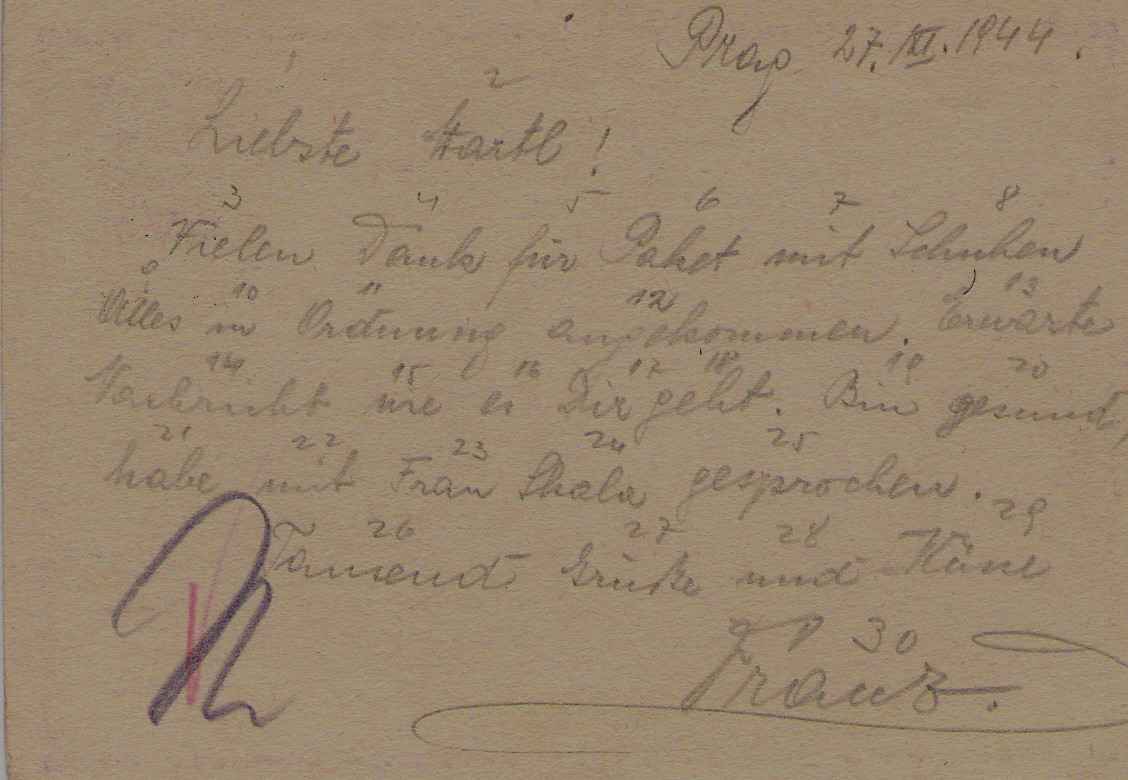
I searched for several years to finding a postcard with numbered words, as described in the article. At one show I picked up this card and recognized the return address as Hagibor Camp. I held the card afraid to turn it over. Finally I did!
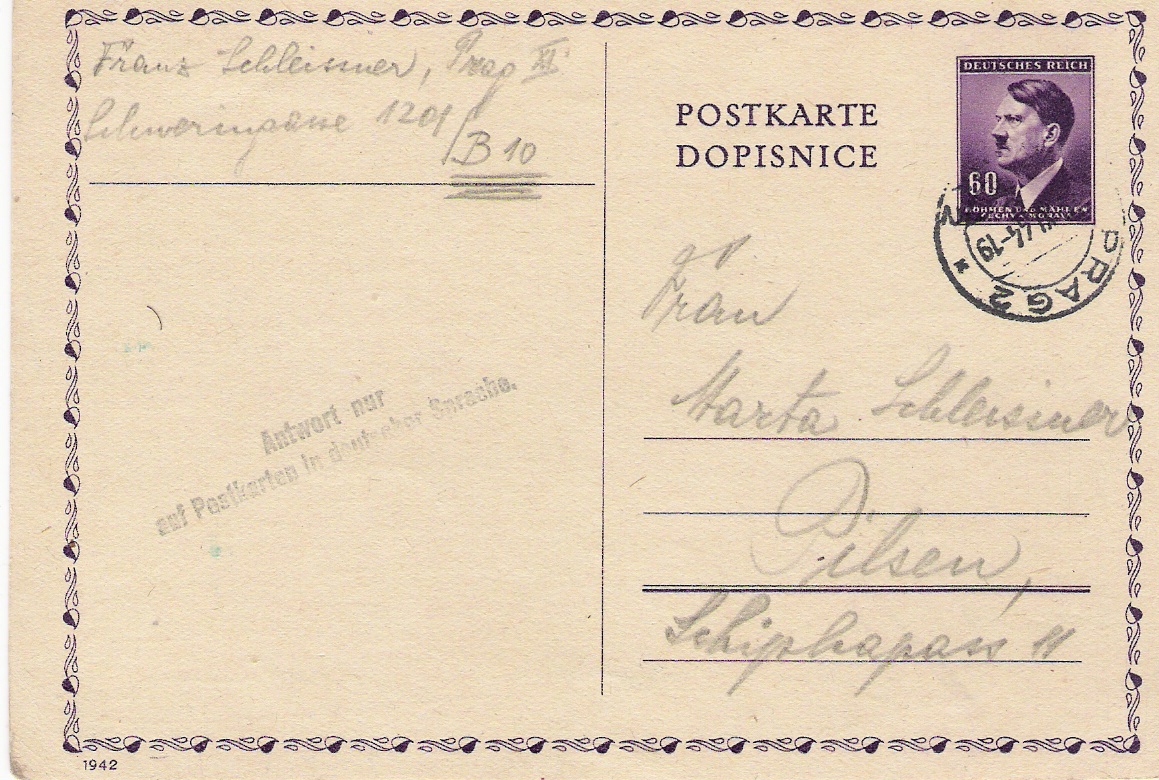
This postal card has a circular date stamp Prague, November 27, 1944, and handstamp indicating that all correspondence should be in German.
Warsaw
Warsaw, the capital of Poland, was one of the first cities occupied by the Nazis. The Jews were forced to move into the poor area of town, which was sealed off and connected to the city by only a bridge. This ghetto became the largest in the General Government, containing almost a half million people. When the Nazis started to liquidate the ghetto, the Jews revolted, and the resulting Warsaw Rebellion ultimately led to the complete and utter destruction of the ghetto.
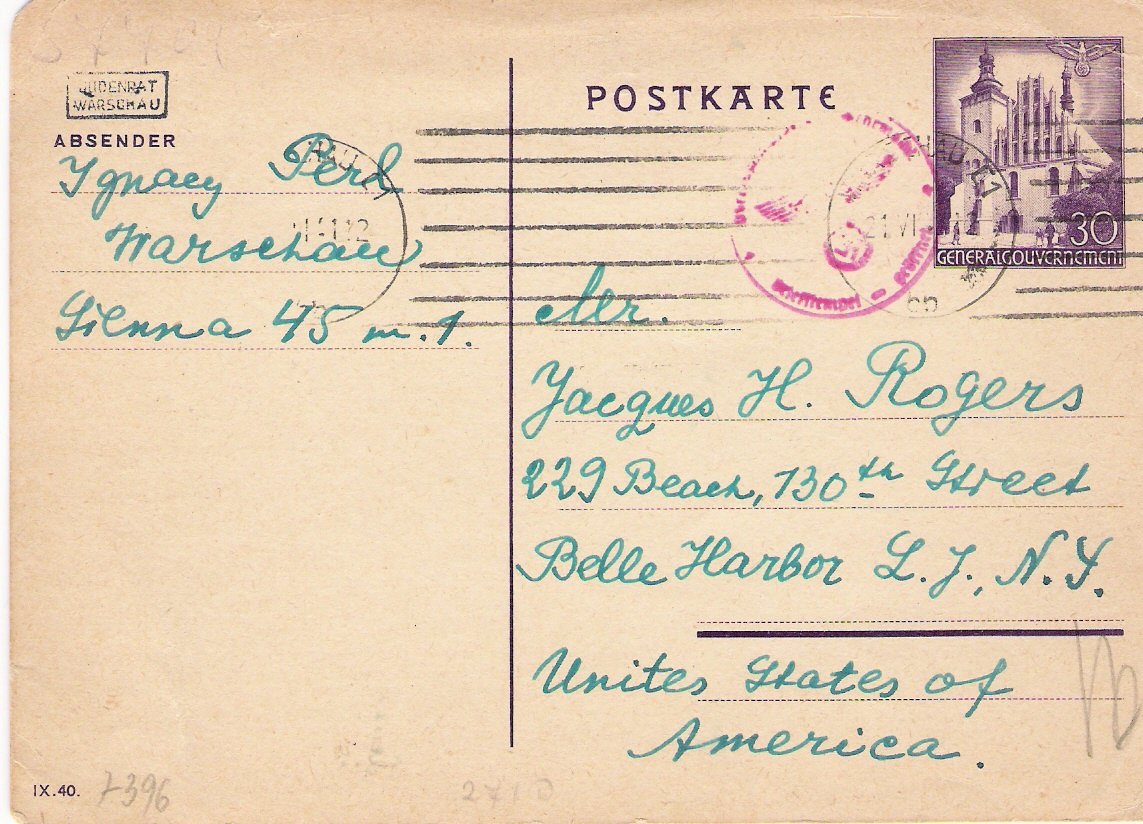
This postal card, sent from the Warsaw ghetto, has a machine Warsaw, June 21, 1942, cancel to Belle Harbor, NY. It was censored by the Nazis, as shown by the circular red handstamp. The small rectangular box in the left corner is the ghetto postal censor.
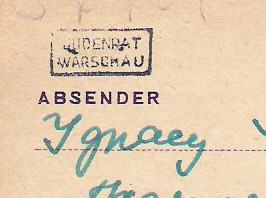
This is the handstamp of the Warsaw ghetto. It reads Judenrat Waschau (Warsaw Jewish Council).
Kleine Festung
The Kleine Festung or “Little Fortress” was a prison in Theresienstadt and contained all the non-Jewish prisoners. Ironically, mail from the Kleine Festung received the Theresienstadt cancellation, by mail from the ghetto did not.
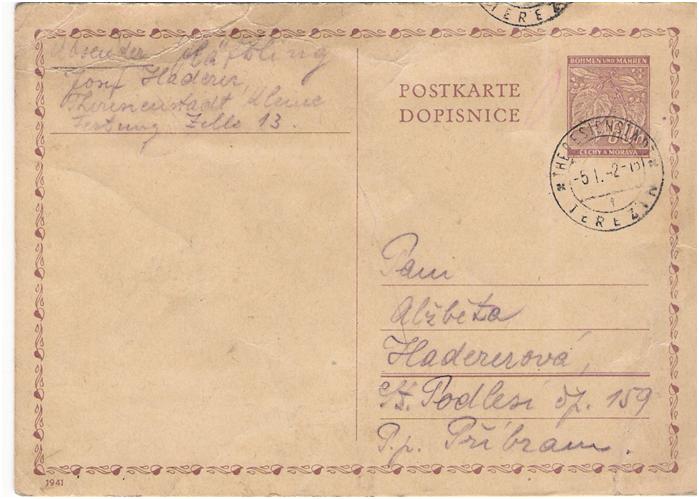
This postcard that was mailed from the Kleine Festung has a circular Theresienstadt cancel dated January 5, 1942. The third line in the return address indicates that the card is from the Kleine Festung.
Theresienstadt
Terezín was a garrison town built between 1780 and 1790 and named for the queen mother Maria Teresa. The Nazis, upon taking over Czechoslovakia, converted the town into a walled ghetto for Jews and the area known as the Kleine Festung, or “Little Fortress,” became a prison for enemies of the state. The Nazis called the new ghetto Theresienstadt.
It soon became “home” for a great number of Jews from occupied Czechoslovakia. Also the Nazis needed a place to put prominent citizens and veterans of WWI, so Theresienstadt became the place for them, as well. The 7,000 non-Jewish Czechs living in Terezín were expelled by the Nazis in the spring of 1942.
During the winter of 1943, the International Red Cross requested an opportunity to inspect the camp. Germany agreed, but only on the condition that the inspection team wait until the following summer. Jewish laborers immediately began to transform the edifice of Theresienstadt from a dirty, dingy camp to a bright, sunny, cheerful Jewish “town.” The Jewish prisoners planted flowers, painted, and scraped. Overcrowding was a problem, and the Nazis did not want the Red Cross team to report these conditions to the world. Instead, they shipped thousands of new arrivals directly to death camps in Eastern Europe instead of sending them to Theresienstadt first.
They also erected fake shops and cafés to imply that the Jews lived in relative comfort. The Danish Jews whom the Red Cross visited lived in freshly painted rooms, and there were not more than three in a room. The guests enjoyed the performance of a children’s opera, Brundar, which was written by inmate Hans Krása. The hoax worked, and the Red Cross produced a positive report about their experience at Theresienstadt.
After the Red Cross visit, the Nazis began to dissolve the camp, sending more and more Jews to Auschwitz until October of 1944, when only 400 people were left in the camp.
Küstrin
Küstrin was a Judenlager (Jewish work camp) located near the town of the same name. Prisoners processed wool, which was used to fabricate military uniforms. The camp opened in January 1943 and was liquidated by the end of 1943.
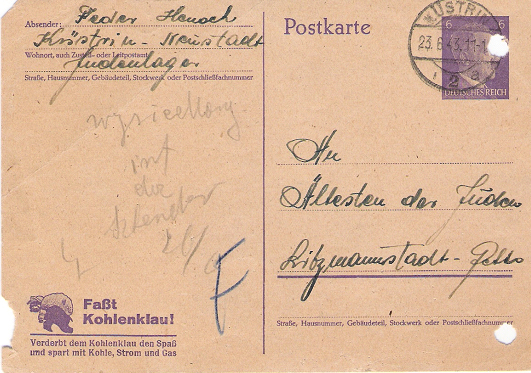
This postcard was sent from Küstrin camp, which is indicated in the third line down in the return address by the word Judenlager. The card was postmarked June 23, 1943.
| Back | Next |
Wittenberge
Kumärkische Zellwolle und Zellulose Aktiongesellschaft was company factory, a Judenlager (Jewish work camp) that specialized in making rayon and cellulose. It was located in Wittenberge, Germany. This subcamp of Neuengamme opened in August 1942 and closed in February 1945.
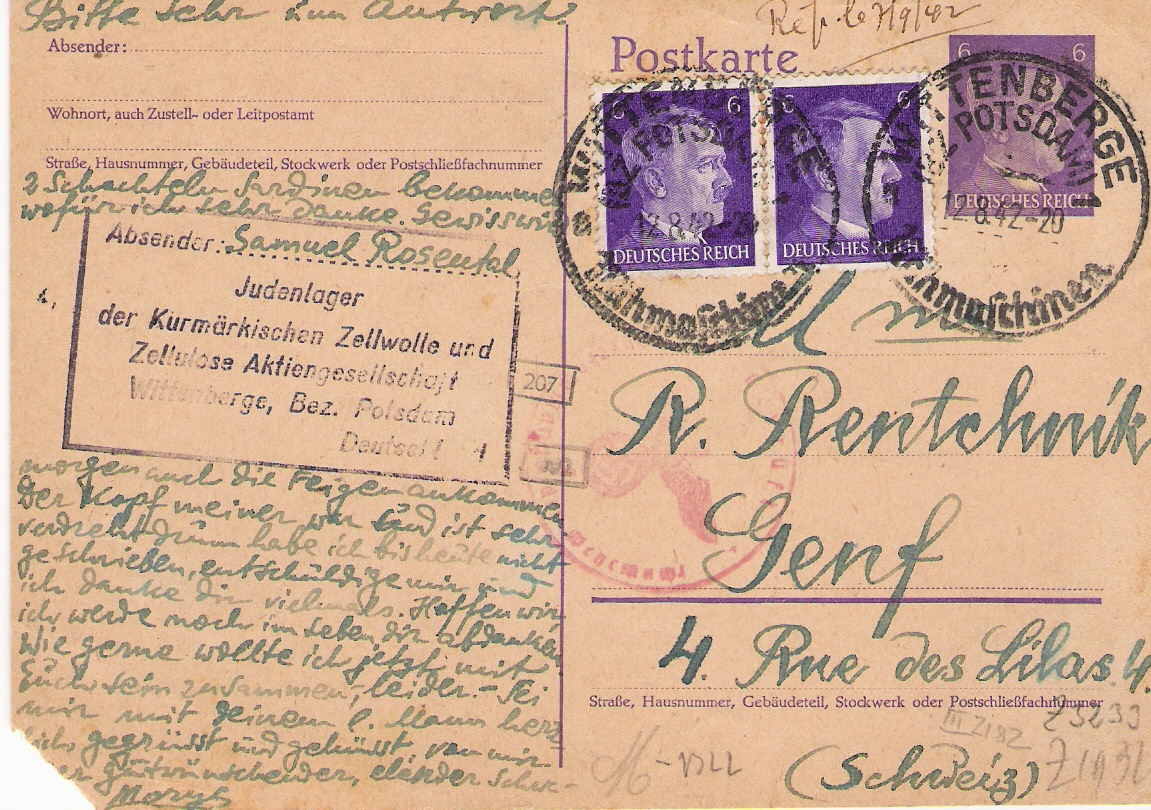
This spectacular cover has a handstamped return address that includes the word Judenlager. It was canceled on August 12, 1942, in Wittenberge. A cancel reads “Wittenberge IBZ Potsdam, Sewing machine.” The card is addressed to Samuel Rosenthal’s in-laws who lived in Geneva, Switzerland. He is pleading with them to do something to get him out. Married before the war, he had been separated from his wife and child.
| Back | Next |
Jewish Work Camps
The Nazis set up a system of concentration camps that encompassed the whole Reich. In Germany and each of the occupied countries, they set up an extensive system of camps and subcamps. The structure of the camp system comprised 16 basic or main camps and hundreds of subcamps that fit into a variety of categories. One such category of subcamps was the Judenarbeitslager (Jewish work camp).
The Judenarbeitslager utilized Jews as slave laborers. The work consisted largely of manual labor, but sometimes their skills were put to use to produce a product or clothing. Most of the time they were worked to death.