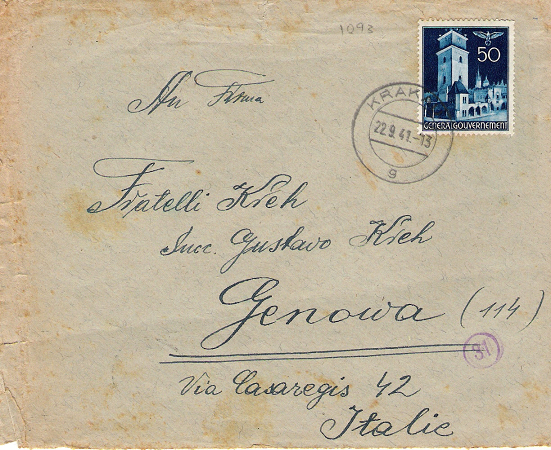
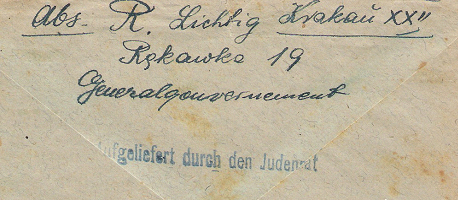
Polish Red Cross
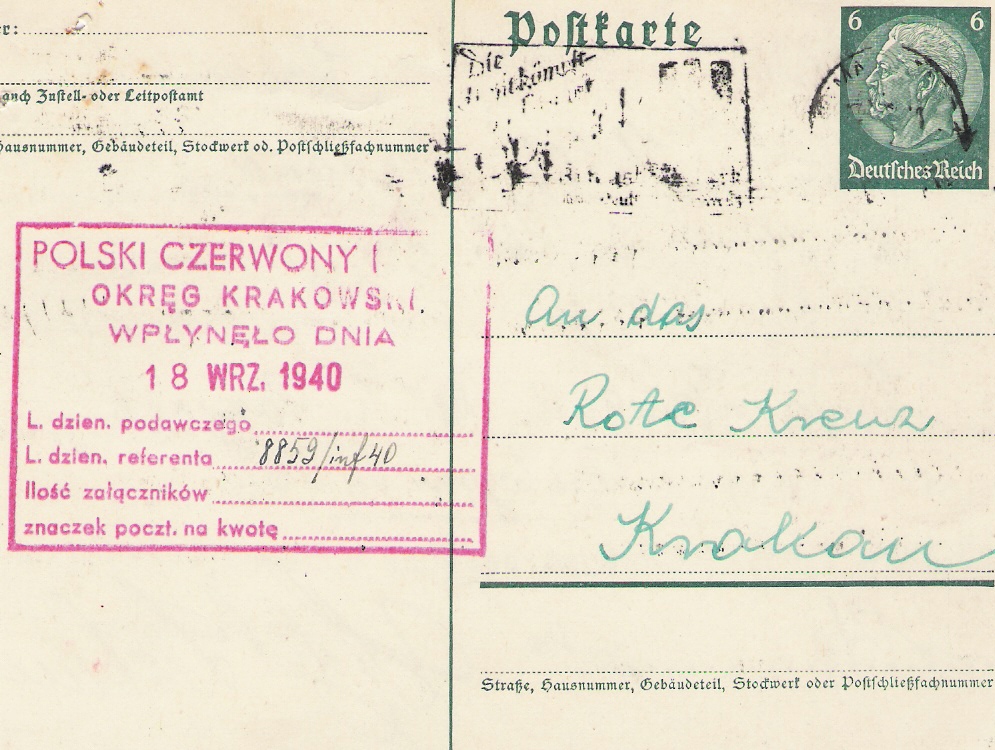
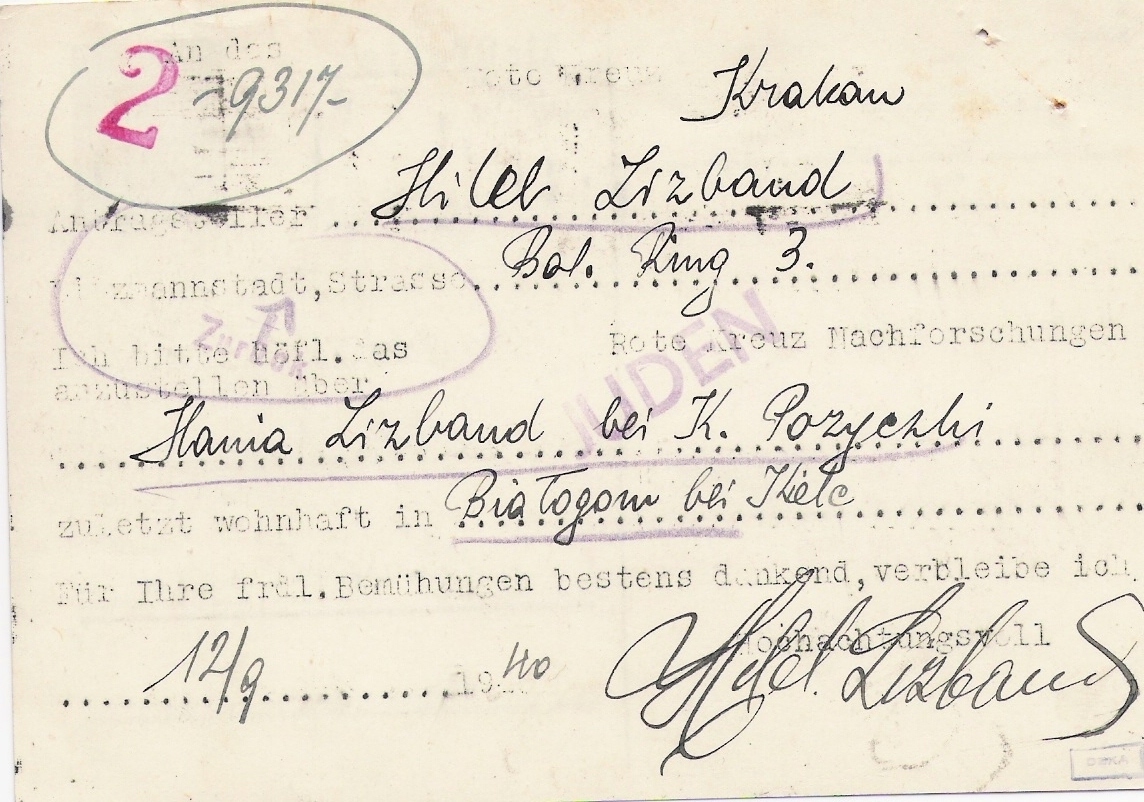
This post inquiry card was mailed from Litzmannstadt to the Polish Red Cross in Cracow. It bears a circular date stamp of December 9, 1940, and an advertising cancel.
Litzmannstadt
Lodz, or Litzmannstadt, was the only ghetto to survive the entire war. To organize and implement Nazi policy within the ghetto, the Nazis chose a Jew named Mordechai Chaim Rumkowski. At the time Rumkowski was appointed the Älteste der Juden (Elder of the Jews), he was 62 years old, with billowy, white hair.
Rumkowski was a firm believer in the autonomy of the ghetto. He started many programs that replaced outside bureaucracy with his own. Rumkowski replaced the German currency with ghetto money that bore his image and signature–soon referred to as “Rumkies.” He also created a post office (and stamps with his image, but they never were used for postage). Because the ghetto had no sewage system, he also established a sewage clean-up department.
Rumkowski created jobs and workshops to employ the residents and worked with the Nazis so they would leave him and the ghetto alone. On June 10, 1944, Heinrich Himmler ordered the liquidation of the Lodz ghetto. Rather than tell residents what was happening, Rumkowski told them that workers were needed in Germany to repair the damages caused by air raids. The first transport left on June 23, with many others following until July 15. On July 15, the transports halted.
By August 1944, the Lodz ghetto had been liquidated. Only a few remaining workers were retained by the Nazis to finish confiscating materials and valuables left in the ghetto. Even Rumkowski and his family were included in these last transports to Auschwitz.
When the Soviets liberated the ghetto on January 19, 1945, they found that only 877 Jews remained of the roughly 245,000 who had lived there.
Piaski
In the Polish town of Piaski, the Nazi established an open ghetto in March 1940 with an associated work camp. Overcrowding was severe, with 20 people assigned to one room. The ghetto was liquidated in March 1943.
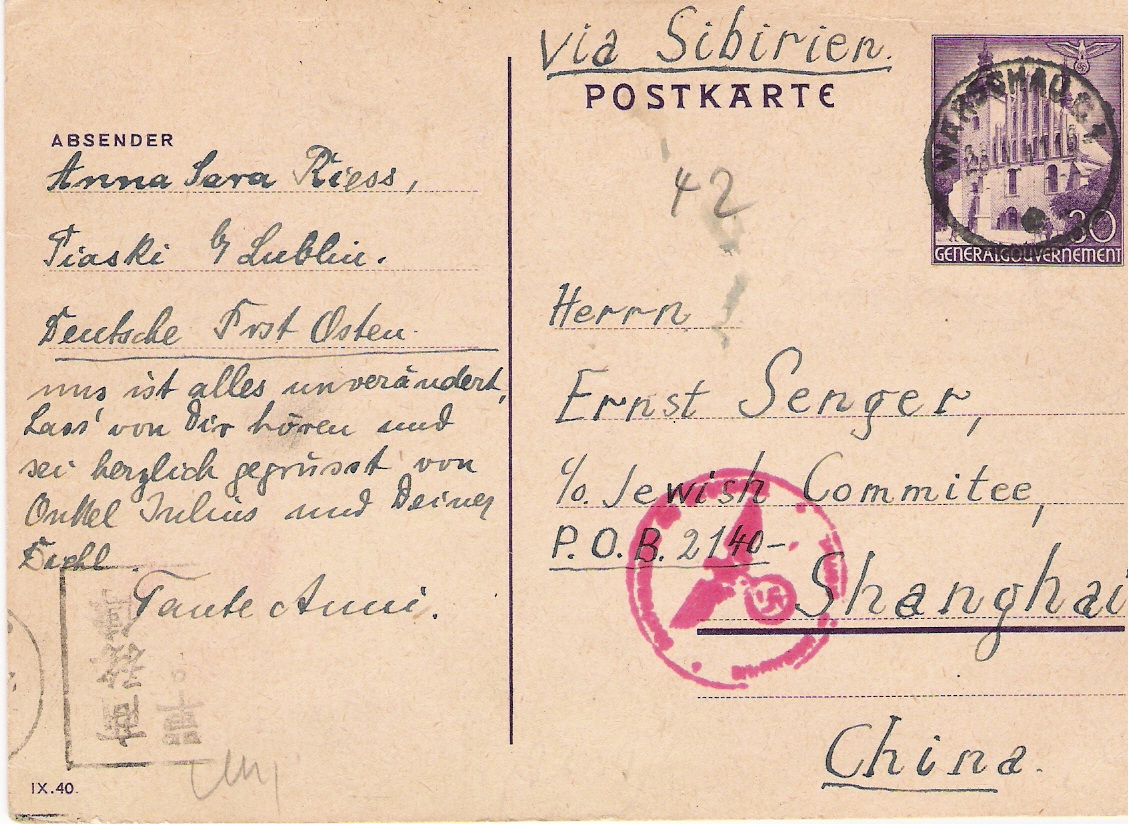
This postal card written has the return address of Anna “Sara” Riess, a German-Jewish woman who had been born in Piaski. When the invasion of Poland took place, all of the naturalized Jews were sent back to their birthplaces in Poland. While the card was written in Piaski, it was posted in Warsaw. It is possible that Riess had made her way there before mailing the card.
| Back | Next |
Ghettos
The term ghetto originated in Italy in the sixteenth century; this was the name given to the Jewish quarter in Venice. During World War II ghettoization of the Jews occurred between the years of 1939 to 1942. Most of the ghettos were in Poland, inside the Nazi administrative region called the Generalgouvernement (General Government). Usually the a poor section of a city or town was designated for the ghetto, and the Jews were required to leave, taking only what they could carry to the ghetto. Once all the Jews entered the ghetto area it was sealed off from the rest of the city.
There was much overcrowding, starvation, and death. There were virtually no jobs and little money to go around. Some ghettos tried to work with the Nazis to create jobs. Within the ghetto, a Judenrat, or Jewish council, was established by the Nazis, and the head of the Judenrat was called the Älteste der Juden (Elder of the Jews). He was in charge of the ghetto government and had to work with the Nazis in governing.
In January 1942 at the Wannsee Conference, the “Final Solution” was formulated. This “solution,” which involved the complete destruction of Jewish people in Europe and Poland, signaled the end of the ghettos. After January of 1942 the Nazis began to liquidate the ghettos and send the residents to the six death camps set up in the Generalgouvernement.
Hagibor
One of the very first covers I obtained in the area of the Holocaust is picture below. It intrigued me because it had the Hebrew word Hagibor, meaning “strength” in the address. At a stamp club meeting I showed this cover, and a gentlemen in the audience explained that Hagibor was a soccer camp for Jewish youth from all over Europe and was located outside of Prague. I could not figure out what this had to do with the Holocaust. So I went to Spertus College Library to research this, and I found an article that indicated that Hagibor was a special camp (Sonderlager) for spouses of mixed marriages.
The article also stated that mail from the Hagibor Camp is generally written on postcards, and the messages consist of no more than 32 words. The censor numbered each word and placed his initials on the card.
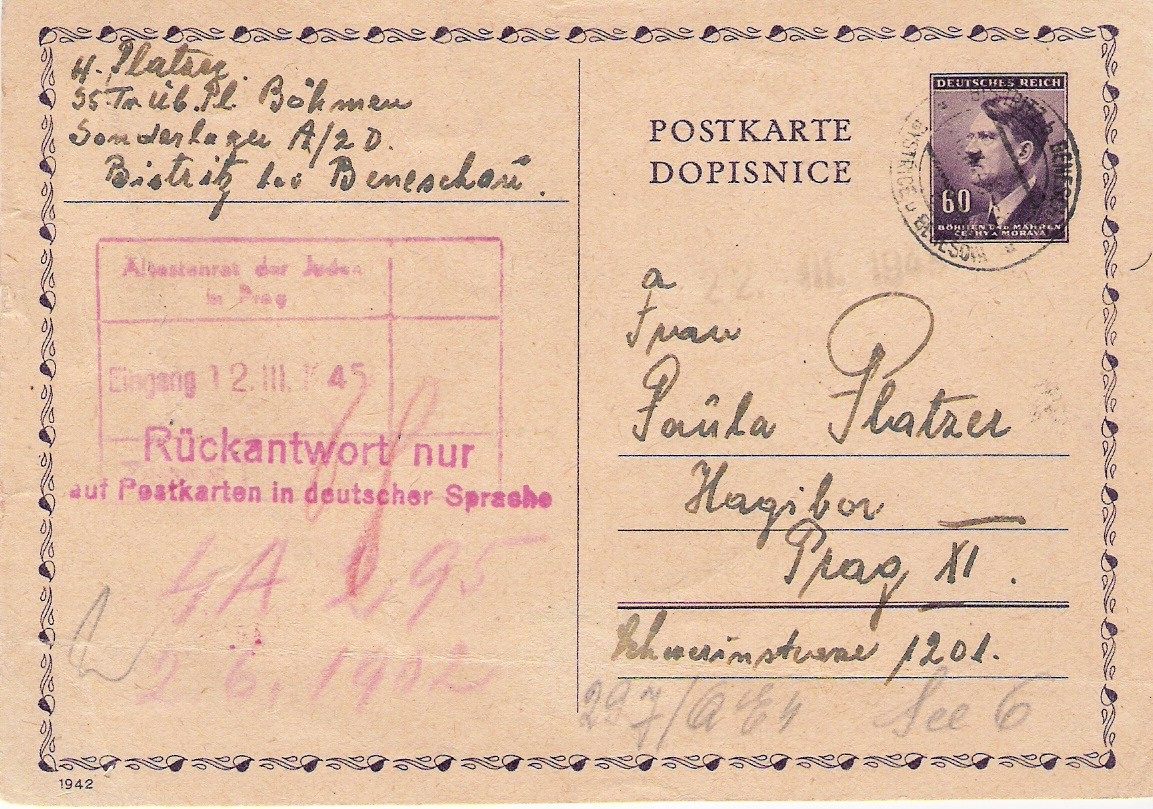
This postal card was sent to Hagibor and has a circular date stamp of March 4, 1945. The markings indicate that the card should be written in German, and there is also a marking from the Prague Jewish Council.
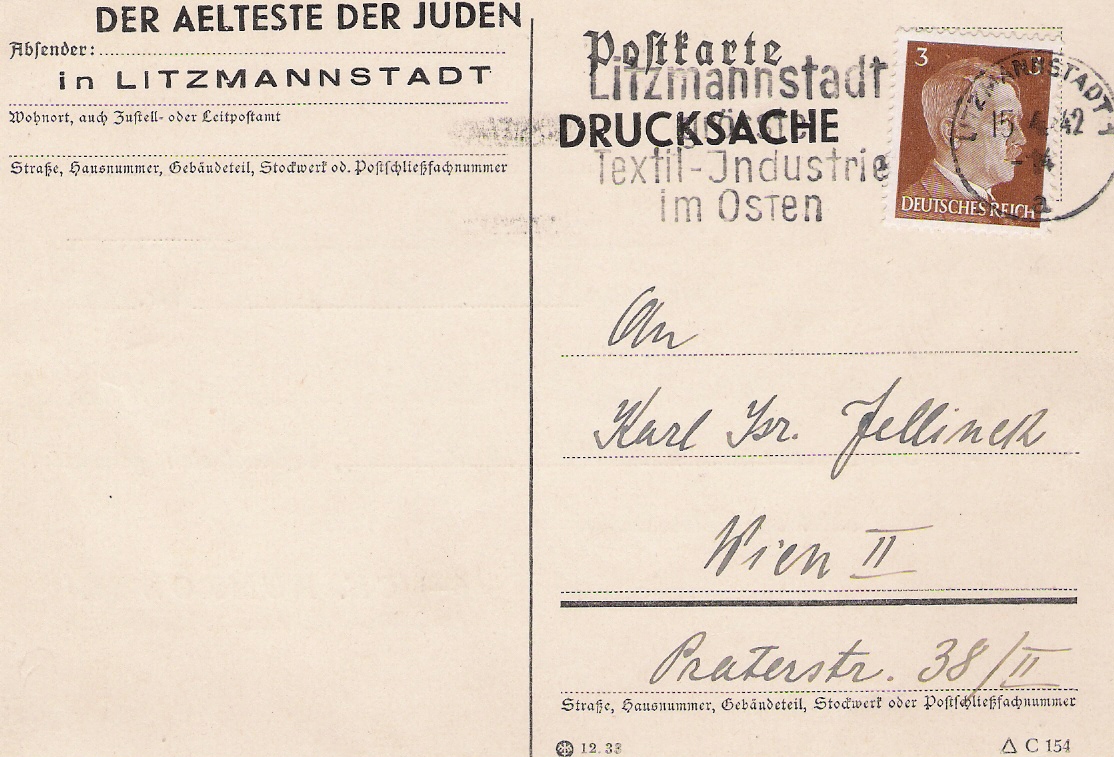
This postcard, sent from Litzmanstadt, has a circular April 15, 1942, cancel and a return address from the Aelteste der Juden in Litzmannstadt. It was addressed to a Jewish individual in Vienna, Austria, who uses the “Israel” middle name.
I searched for several years to finding a postcard with numbered words, as described in the article. At one show I picked up this card and recognized the return address as Hagibor Camp. I held the card afraid to turn it over. Finally I did!
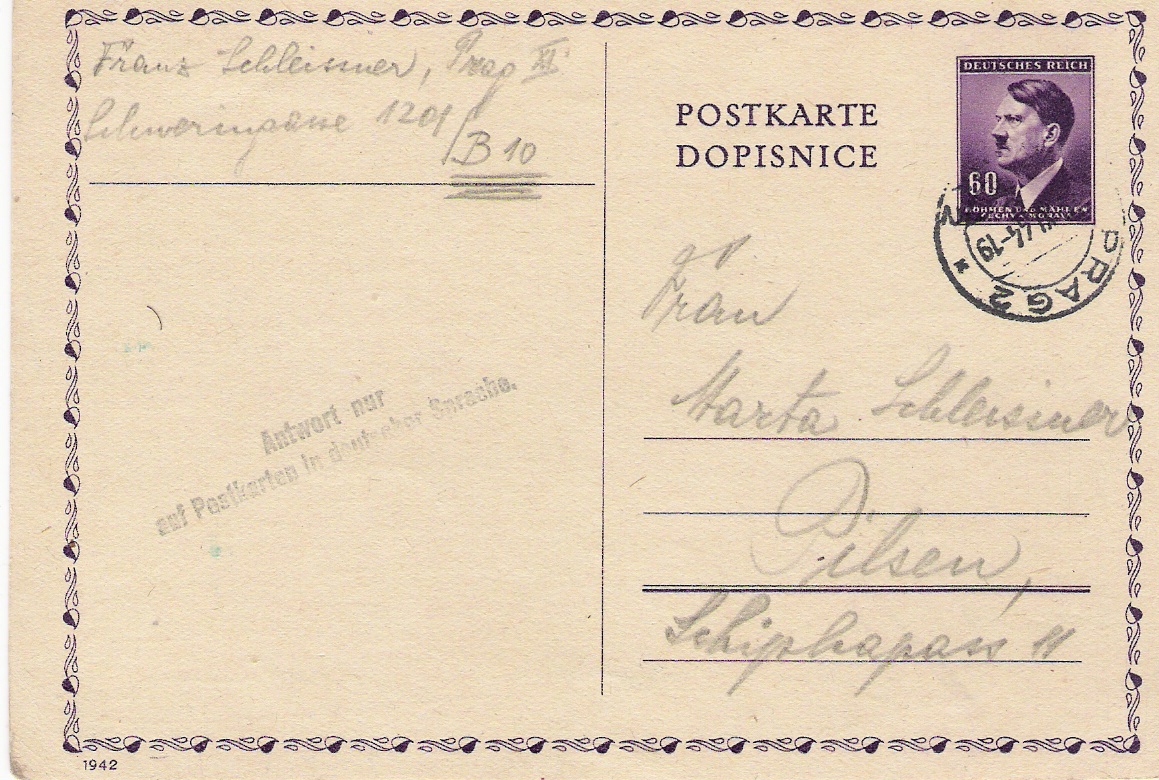
This postal card has a circular date stamp Prague, November 27, 1944, and handstamp indicating that all correspondence should be in German.
Warsaw
Warsaw, the capital of Poland, was one of the first cities occupied by the Nazis. The Jews were forced to move into the poor area of town, which was sealed off and connected to the city by only a bridge. This ghetto became the largest in the General Government, containing almost a half million people. When the Nazis started to liquidate the ghetto, the Jews revolted, and the resulting Warsaw Rebellion ultimately led to the complete and utter destruction of the ghetto.
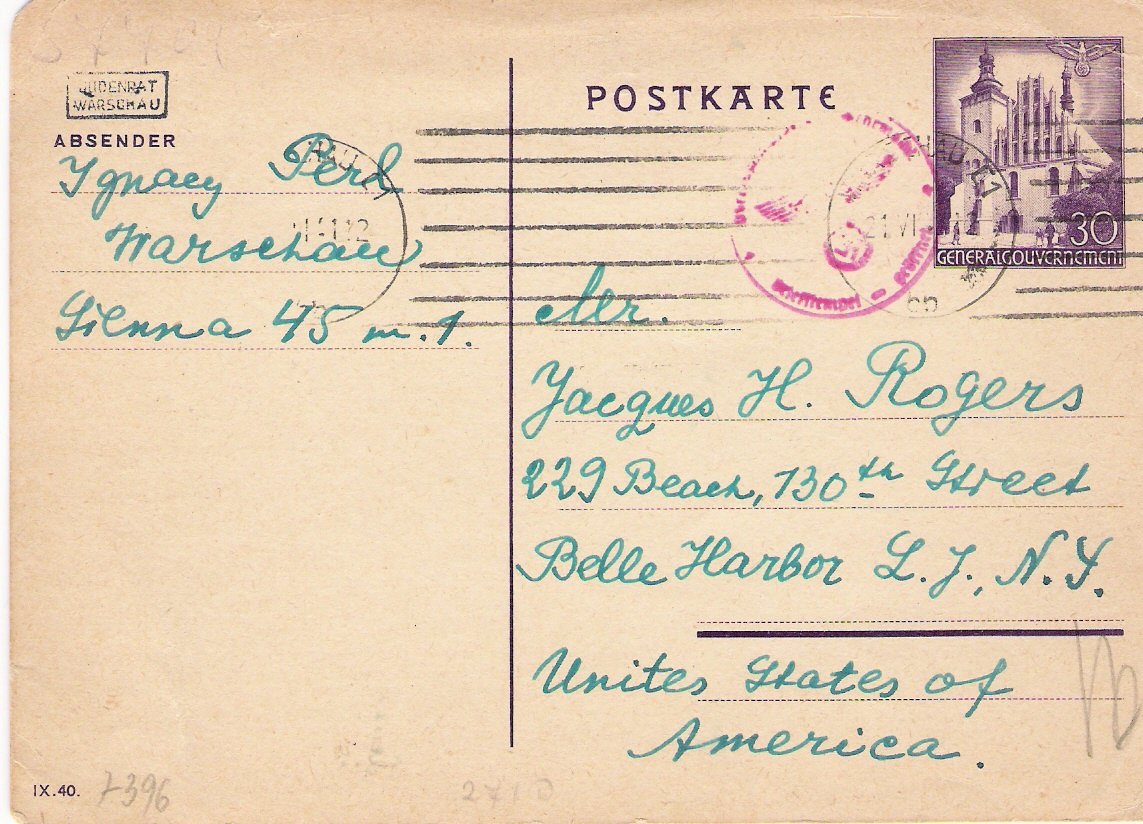
This postal card, sent from the Warsaw ghetto, has a machine Warsaw, June 21, 1942, cancel to Belle Harbor, NY. It was censored by the Nazis, as shown by the circular red handstamp. The small rectangular box in the left corner is the ghetto postal censor.
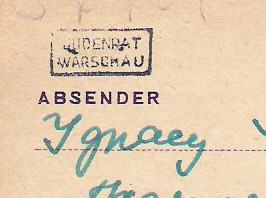
This is the handstamp of the Warsaw ghetto. It reads Judenrat Waschau (Warsaw Jewish Council).