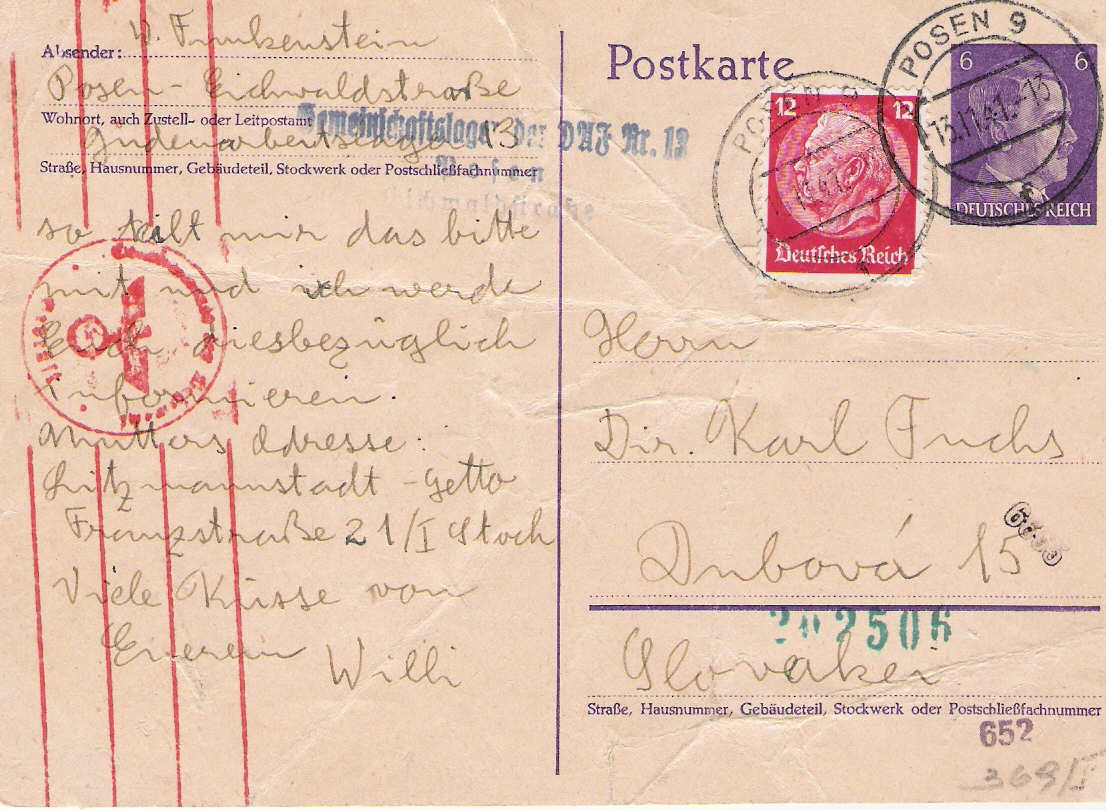
Eichenwald was located in the Polish occupied territory near Posen. Established in July 1941, it served several companies, including Phillipp Holzmann, Katz, and Sager & Wörner. The camp closed August of 1943.
This postal card has an additional 12-pfg stamp. It was sent to Dubova and was censored through the Vienna office of the OKW. The third line of the return address indicates the Judenarbeitslager.
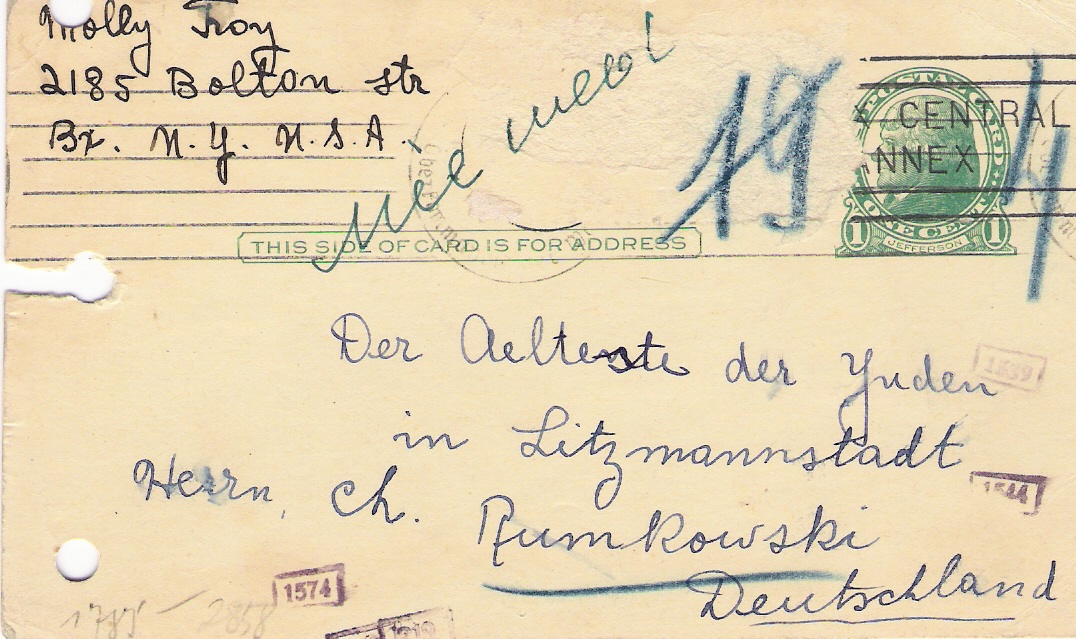
This postal card was sent from the Bronx, NY, to the Aelteste der Juden Chaim Rumkowski. It is an inquiry card, looking for residents of the town. Three holes were punched on the left side, and the card was placed in a loose-leaf binder.
This letter was addressed to a prisoner detained in the Kleine Festung and was returned to sender.
It has a circular date stamp July 13, 1942, and a handstamped Return to sender.
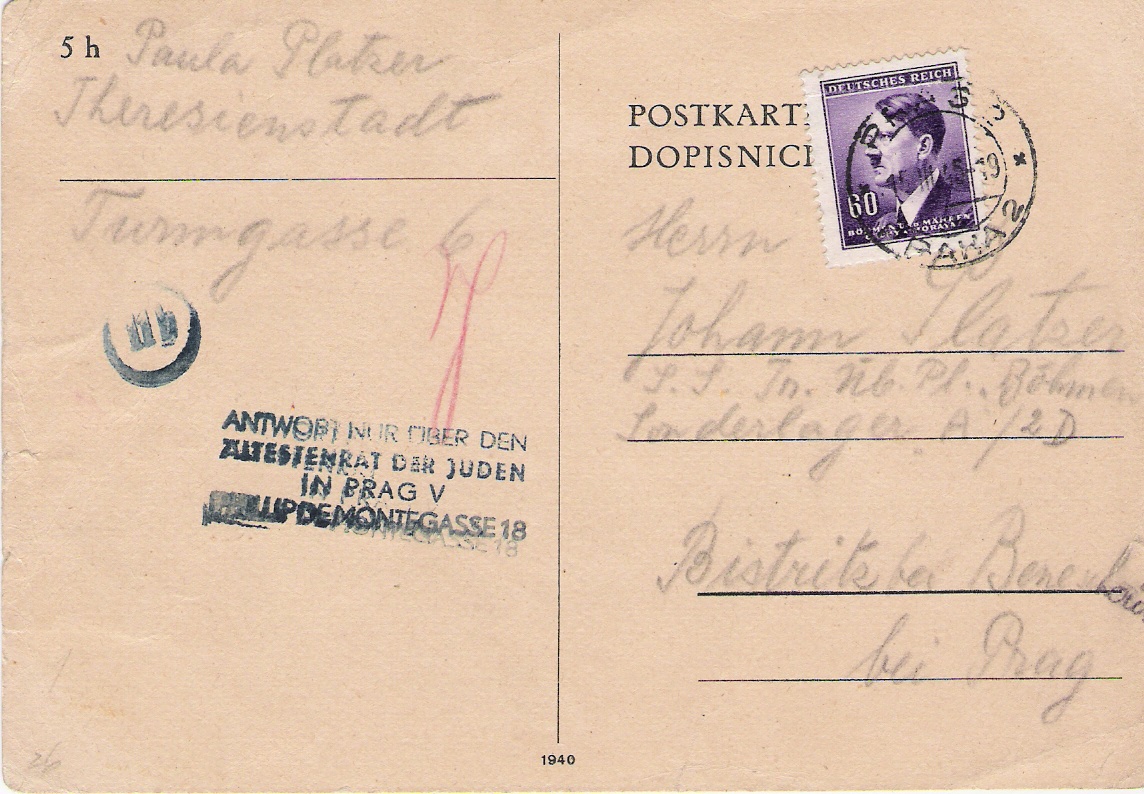
This postcard was sent from Theresienstadt and is marked with the handstamp of the Prague Jewish Committee and an 11b routing mark. It is has a circular Prague cancel, March 15, 1945. The card was sent to a special work camp (Sonderlager).
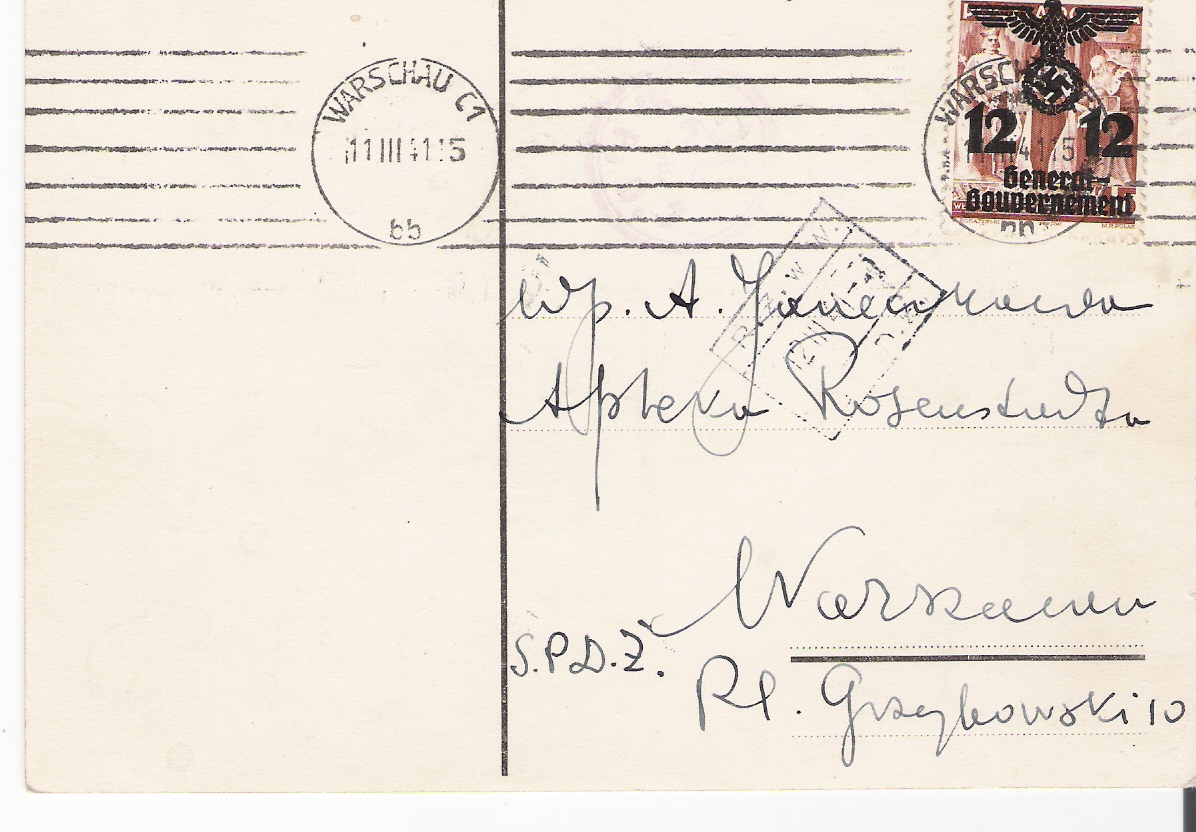
The post office in the Warsaw ghetto was run by the Judenrat government, but the money it derived from the sale of postal items went to the main post office in Warsaw. In order for the ghetto post office to pay the workers, a surtax was applied to the mail that was delivered to the residents of the ghetto.
This postcard was sent to the Warsaw ghetto. It has a machine cancel March 11, 1941, with the ghetto receiving handstamp and the circular surtax marking.
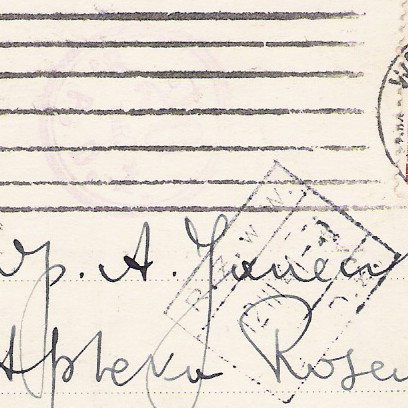
This image shows the markings enlarged: the circular surtax stamp barely visible at the top left and the rectangular ghetto receiving handstamp at the bottom right.
Auschwitz is one of the most notorious concentration camps established by the Nazis during the Second World War. The name of the camp alone is synonymous with genocide and extermination. Auschwitz was located near the town of Oswiecim, Poland, and it grew into a vast complex of three main camps and over 70 subcamps.
From the camp’s beginnings in May 1940 until January 1945, when most surviving Auschwitz prisoners were marched off by their German captors and Soviet troops liberated the camp, approximately 405,000 prisoners of both sexes, from nearly all European countries were registered, assigned serial numbers, and incarcerated there. Only a fraction of the 2.5 million people who passed the gates survived the camp.
Sachsenhausen, one of the early concentration camps, was established in the summer of 1936. Located outside of Berlin, the main function of Sachsenhausen was to train officers to be commandants for the other camps.
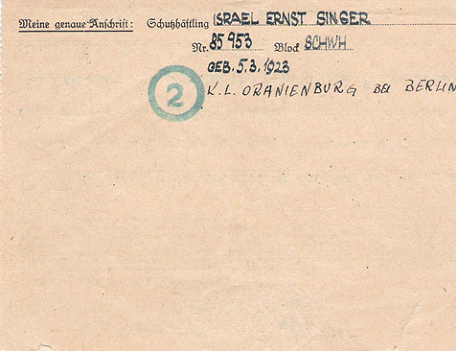
Early in 1945 the Allies broke through to Berlin and started bombing on a nightly basis, creating large craters in the streets. The Nazis gathered about thousand Jews and transferred them from Auschwitz to Sachsenhausen, where a subcamp named Schwarzweide was established. This subcamp was responsible for filling in the bomb craters left by the Allied air assaults in Berlin. Of those thousand prisoners, less than a dozen survived the war. We can identify mail from the Schwarzheide subcamp by the initials SCHWH in the return address.
The Bergen-Belsen concentration camp was set up originally as a special camp to house Jews to be traded for German nationals held abroad. This plan never came to fruition, and Bergen-Belsen was one of the first camps liberated by the Allied troops. Pictures of the emaciated men and women taken by Margaret Bourke White appeared on the cover of LIFE magazine.
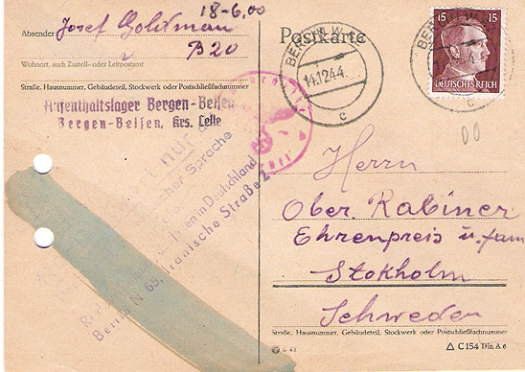
This cover was written at Bergen-Belsen concentration camp and transported to the Berlin Jewish Council. It was mailed through the postal system in Berlin on December 14, 1944. The card was censored and checked for hidden messages using a blue chemical strip. It finally reached Rabbi Ehrenpreis in Stockholm, Sweden.
In the mid-eighteenth century, the town of Weimar was a seat of the German Enlightenment. It was home to some of the greatest German minds, including Goethe, Schiller, and Bach. However, Weimar also would become the site of Buchenwald, one of the largest concentration camps inside the 1937 German borders.
The camp, built to house opponents of the Nazi regime, was constructed by the prisoners themselves. After Kristallnacht and the beginning of the war, it became a major camp that incarcerated Polish and Soviet prisoners.
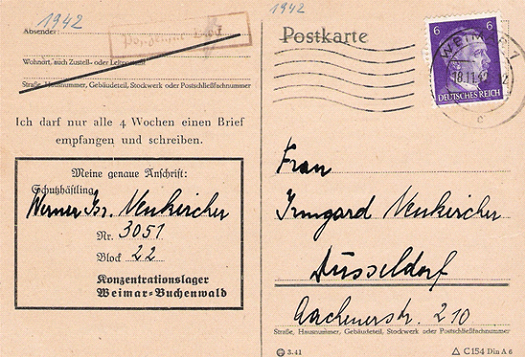
On this postcard, sent from the Buchenwald concentration camp, the Israel middle name identifies the sender as a Jewish inmate. The card is dated November 11, 1942, and has brief preprinted instructions to the recipient, indicating that “I am only allowed to write and receive one letter every 4 weeks.”
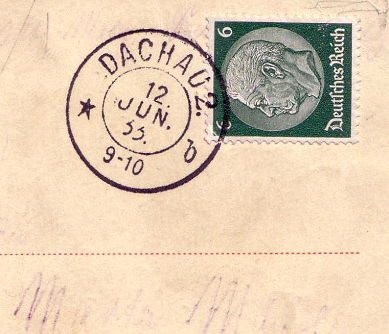
Hitler came to power on March 5, 1933, and the official opening of the first concentration camp was March 22, 1933: This was Dachau. This cover below is dated June 12, 1933, three months after the opening of Dachau opened.
A Personal Story
Many years ago I found an auction catalog containing 12 lots of postal cards from Dachau. The first listing was a postal card similar to this one, canceled March 22, 1933, the first day the camp was opened. We stamp collectors love to find a cancellation on the first day of an event, and the catalog description did not indicate it was a special date. I called the auctioneer, and before I even had a chance to explain, he said, “I know! You are the tenth person to call and tell me that I missed that March 22 is the opening of Dachau.”
He gave me information on the phone auction for the item, and I called in. The first time around, I bid $300.00; the second time, I had to calculate the cost of flying to New York, staying in a hotel, and dining, so I bid $1,100.00. The next time the bid came my way, it was close to $2,000.00, and I dropped out. The lot sold for over $2,000.00. I told this story in a presentation in 1986 at AMERIPEX, an international philatelic exposition. A gentleman in the audience raised his hand and said that he was the one who bought that cover.