Auschwitz

Auschwitz is one of the most notorious concentration camps established by the Nazis during the Second World War. The name of the camp alone is synonymous with genocide and extermination. Auschwitz was located near the town of Oswiecim, Poland, and it grew into a vast complex of three main camps and over 70 subcamps.

From the camp’s beginnings in May 1940 until January 1945, when most surviving Auschwitz prisoners were marched off by their German captors and Soviet troops liberated the camp, approximately 405,000 prisoners of both sexes, from nearly all European countries were registered, assigned serial numbers, and incarcerated there. Only a fraction of the 2.5 million people who passed the gates survived the camp.
Sachsenhausen

Sachsenhausen, one of the early concentration camps, was established in the summer of 1936. Located outside of Berlin, the main function of Sachsenhausen was to train officers to be commandants for the other camps.

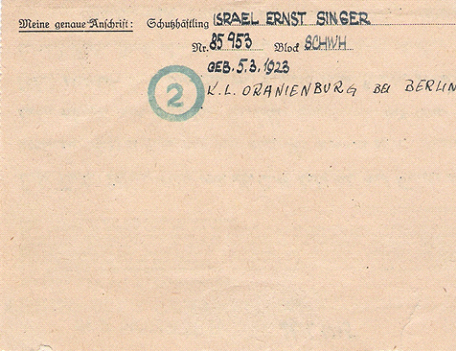
Early in 1945 the Allies broke through to Berlin and started bombing on a nightly basis, creating large craters in the streets. The Nazis gathered about thousand Jews and transferred them from Auschwitz to Sachsenhausen, where a subcamp named Schwarzweide was established. This subcamp was responsible for filling in the bomb craters left by the Allied air assaults in Berlin. Of those thousand prisoners, less than a dozen survived the war. We can identify mail from the Schwarzheide subcamp by the initials SCHWH in the return address.

Bergen-Belsen

The Bergen-Belsen concentration camp was set up originally as a special camp to house Jews to be traded for German nationals held abroad. This plan never came to fruition, and Bergen-Belsen was one of the first camps liberated by the Allied troops. Pictures of the emaciated men and women taken by Margaret Bourke White appeared on the cover of LIFE magazine.

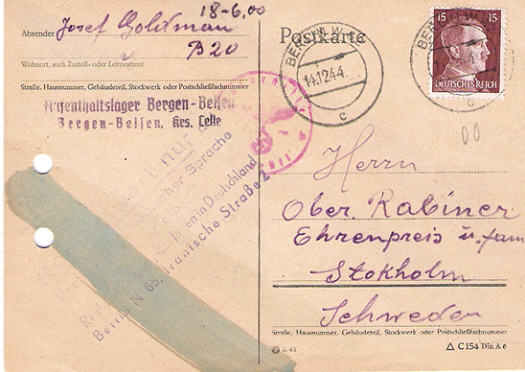
This cover was written at Bergen-Belsen concentration camp and transported to the Berlin Jewish Council. It was mailed through the postal system in Berlin on  December 14, 1944. The card was censored and checked for hidden messages using a blue chemical strip. It finally reached Rabbi Ehrenpreis in Stockholm, Sweden.


Back Next

Buchenwald

In the mid-eighteenth century, the town of Weimar was a seat of the German Enlightenment. It was home to some of the greatest German minds, including Goethe, Schiller, and Bach. However, Weimar also would become the site of Buchenwald, one of the largest concentration camps inside the 1937 German borders.

The camp, built to house opponents of the Nazi regime, was constructed by the prisoners themselves. After Kristallnacht and the beginning of the war, it became a major camp that incarcerated Polish and Soviet prisoners.

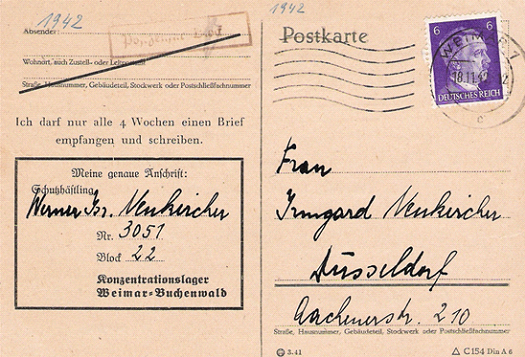
On this postcard, sent from the Buchenwald concentration camp, the Israel middle name identifies the sender as a Jewish inmate.  The card is dated November 11, 1942, and has brief preprinted instructions to the recipient, indicating that “I am only allowed to write and receive one letter every 4 weeks.”

Dachau

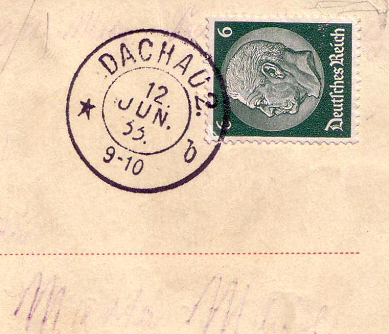
Hitler came to power on March 5, 1933, and the official opening of the first concentration camp was March 22, 1933: This was Dachau. This cover below is dated June 12, 1933, three months after the opening of Dachau opened.

A Personal Story

Many years ago I found an auction catalog containing 12 lots of postal cards from Dachau. The first listing was a postal card similar to this one, canceled March 22, 1933, the first day the camp was opened. We stamp collectors love to find a cancellation on the first day of an event, and the catalog description did not indicate it was a special date. I called the auctioneer, and before I even had a chance to explain, he said, “I know! You are the tenth person to call and tell me that I missed that March 22 is the opening of Dachau.”

He gave me information on the phone auction for the item, and I called in. The first time around, I bid $300.00; the second time, I had to calculate the cost of flying to New York, staying in a hotel, and dining, so I bid $1,100.00. The next time the bid came my way, it was close to $2,000.00, and I dropped out. The lot sold for over $2,000.00. I told this story in a presentation in 1986 at AMERIPEX, an international philatelic exposition. A gentleman in the audience raised his hand and said that he was the one who bought that cover.

Dachau was initially a camp for political and ideological opponents of the Nazi regime, e.g., union leaders, communists, and social democrats. Jews who were members of these groups were detained, but mass arrests of Jews did not take place until Kristallnacht, five and a half years later.

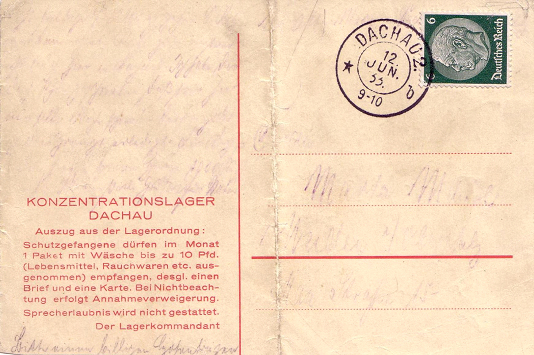
This image is the full post card. The preprinted instructions indicate that

Protective prisoners may receive 1 package of underwear every month up to 10 lbs. (food, smoking materials, etc., are excluded). In addition, one letter and one postcard are permitted. Nonobservance of the rules will result in confiscation. Visitation is not permitted.

The writer, Otto Marx, was a merchant in Bavaria. He later wrote a book about his experiences in Dachau.

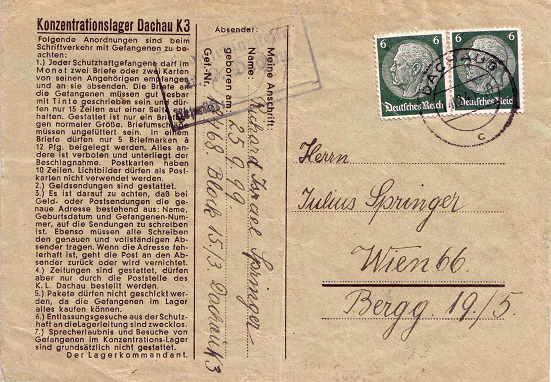
It is very unusual to see mail from Jewish inmates in the concentration camps; they were seldom accorded the privilege to write letters. We can identify these inmates and their mail by the Sara and Israel middle names.

This cover from Dachau contains the Israel middle name: Richard “Israel” Springer. The letter is dated February 4, 1940. The preprinted instructions inform the sender of what can be sent to the inmate.

Family Camp

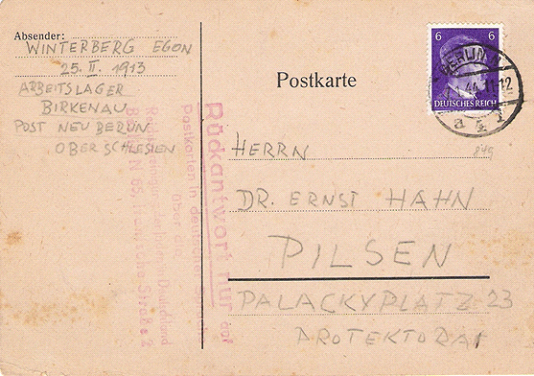
At Auschwitz 2, or Birkenau, several distinctive camps were established. The family camp established by the Nazis was modeled after the Theresienstadt ghetto. It was supposed to be a model camp where the International Red Cross would visit and the see how well the Jews were treated under the Nazis. This never came to fruition.

On September 8, 1943, the first residents of the Family Camps were transported to Auschwitz: 5000 Czechoslovakian Jews. They set up a model town with schools, a government, and postal system. The Nazis asked them to write post cards to their friends and relatives on March 9, 1944. The next day all the people in the family camp were gassed. The Nazis kept sending out these cards months after those who wrote them were killed. The Nazis parlance called this a Brief Aktion. Brief means “letter” and Aktion by Nazi definition is the German word for an “action” or campaign. When used by the SS or Gestapo, it often meant the roundup or murder of Jews.

This postcard was sent to Pislen, Czechoslovakia, with the return address Arbeitslager Birkenau, where the family camp was located. It was distributed through the Jewish Association in Berlin.

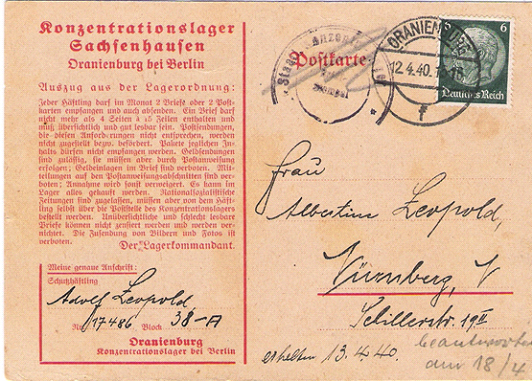
In September 1939 some 900 stateless Jews (stateless because their citizenship was revoked by the Nazis) were arrested in Berlin and placed in barracks 37, 38, 39 in Sachsenhausen. Within several months of the prisoners’ arrival at the camp, the barracks windows and doors were sealed up and the inmates were engaged in strenuous physical activity for hours on end. These tortures increased an already-high death rate in the camp.


Back Next

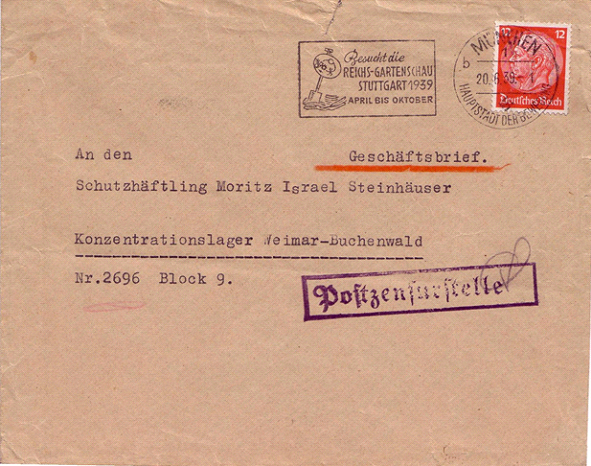
Mail into the concentration camps is even rarer than mail sent out by Jews because after it was delivered to the inmates, it was collected and destroyed. The cover shown has the Israel middle name and was sent into Buchenwald. So how did this item survive? My theory is Max “Israel” Steinhauser was arrested on Kristallnacht in November 1938 and was released in June 1939, the same as the cancel on the stamp. Hitler released thousands of Jews a few months after their arrest, requiring them to leave the country. I believe that Mr. Steinhauser was one of those individuals and was able to sneak the letter out of Buchenwald when he left.


Back Next