Wittenberge

Kumärkische Zellwolle und Zellulose Aktiongesellschaft was company factory, a Judenlager (Jewish work camp) that specialized in making rayon and cellulose. It was located in Wittenberge, Germany. This subcamp of Neuengamme opened in August 1942 and closed in February 1945.
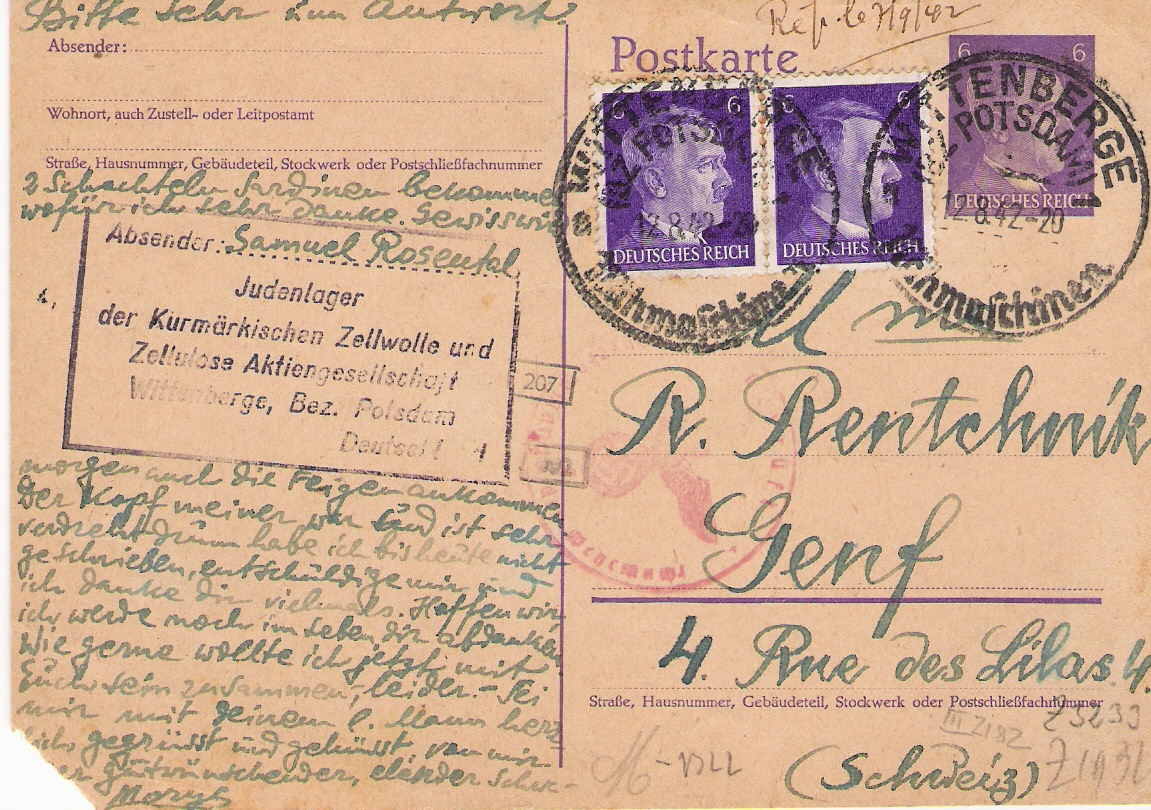
This spectacular cover has a handstamped return address that includes the word Judenlager. It was canceled on August 12, 1942, in Wittenberge. A cancel reads “Wittenberge IBZ Potsdam, Sewing machine.” The card is addressed to Samuel Rosenthal’s in-laws who lived in Geneva, Switzerland. He is pleading with them to do something to get him out. Married before the war, he had been separated from his wife and child.

Back Next

Berlin Cancellation

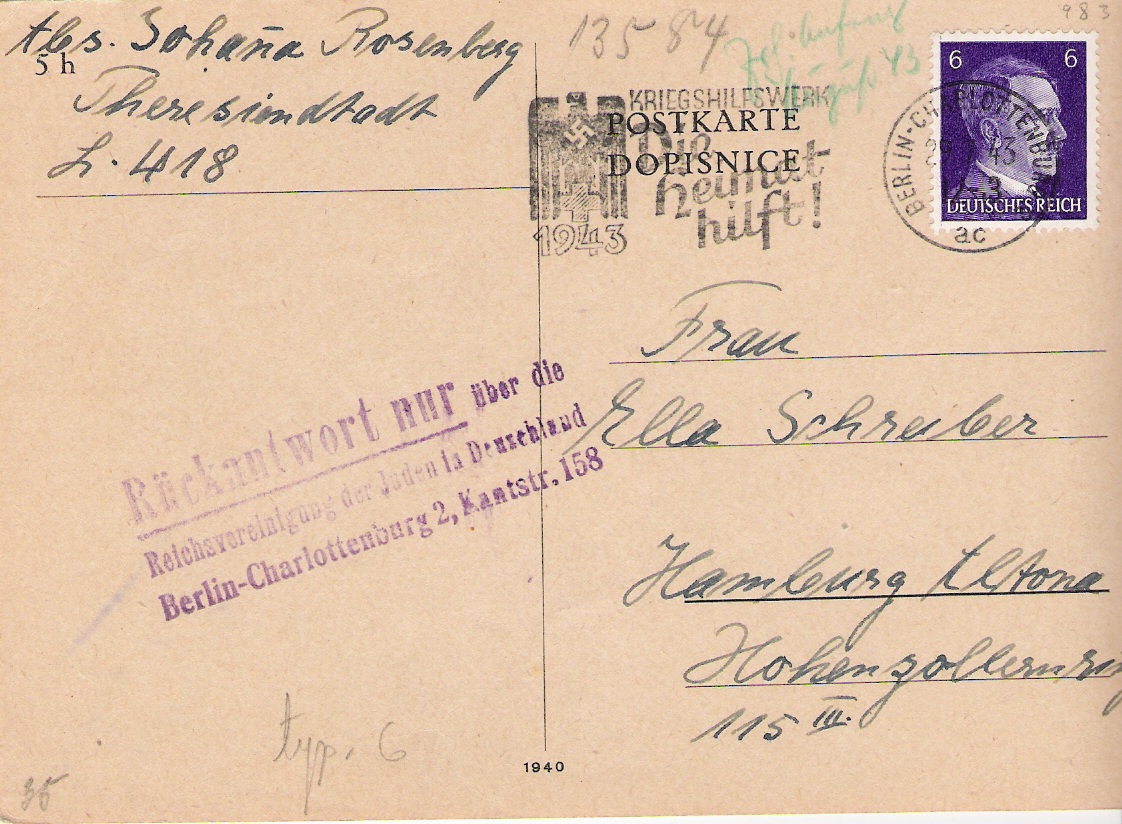
The mail from Theresienstadt was collected in a central office and shipped to the Jewish councils in either Prague or Berlin to be posted and distributed. It appears that Jewish mail going out of Theresienstadt did not receive a cancel from that city, only from Berlin or Prague.

This post card was sent from a Theresienstadt address. It was transported to Berlin and canceled with a Berlin circular July 29, 1943. A handstamp from the Jewish Council of Berlin was placed on the card, which was then sent on to Hamburg.

Eichenwald

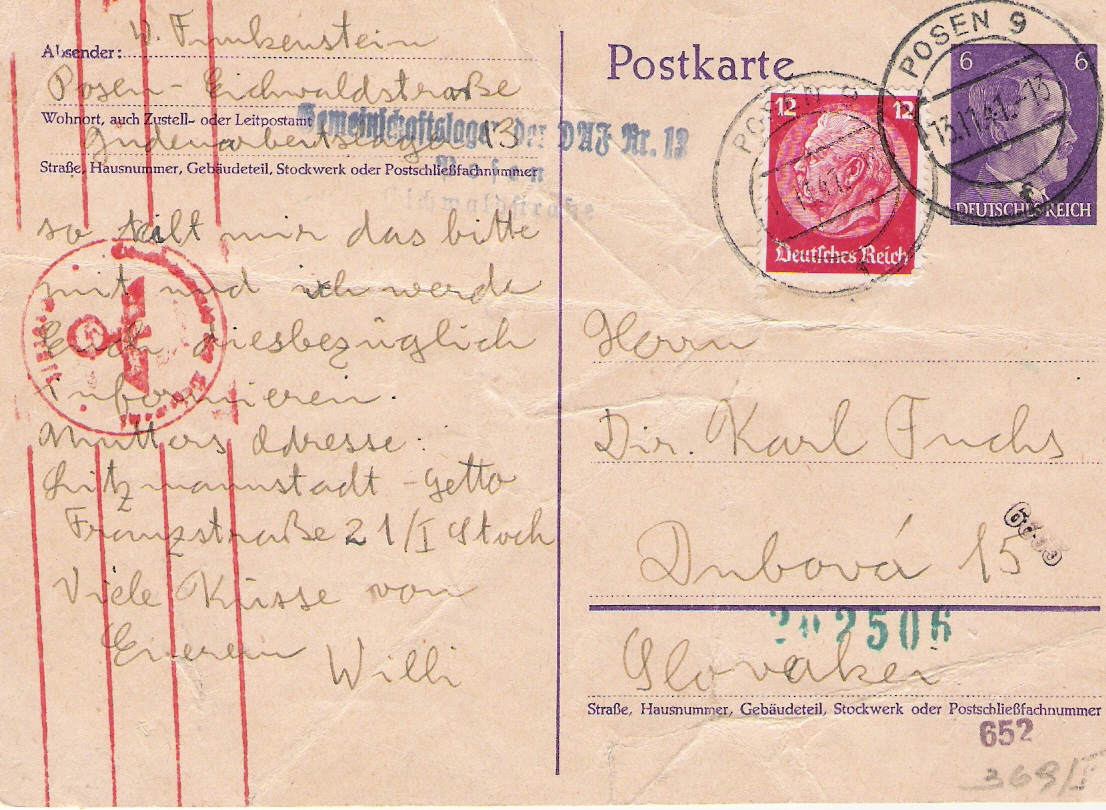
Eichenwald was located in the Polish occupied territory near Posen. Established in July 1941, it served several companies, including Phillipp Holzmann, Katz, and Sager & Wörner. The camp closed August of 1943.

This postal card has an additional 12-pfg stamp. It was sent to Dubova and was censored through the Vienna office of the OKW. The third line of the return address indicates the Judenarbeitslager.


Back Next

Prague Cancellation

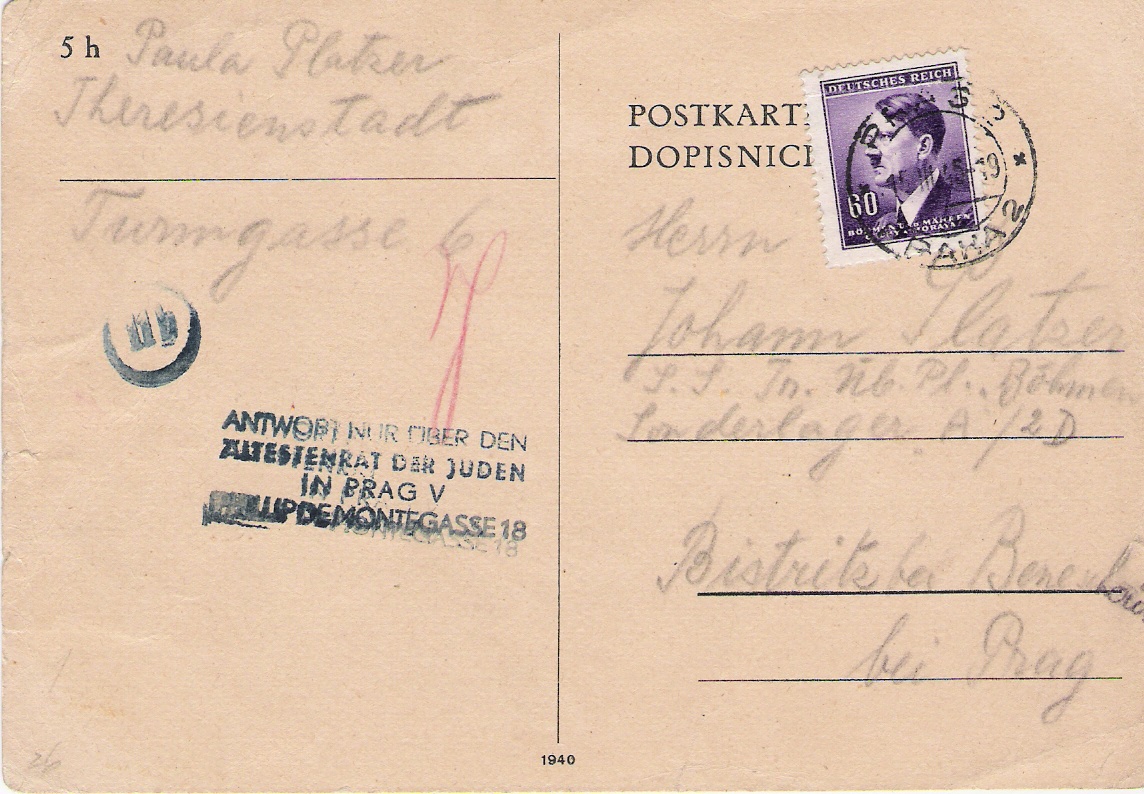
This postcard was sent from Theresienstadt and is marked with the handstamp of the Prague Jewish Committee and an 11b routing mark. It is has a circular Prague cancel, March 15, 1945. The card was sent to a special work camp (Sonderlager).

Sachsenhausen

Sachsenhausen, one of the early concentration camps, was established in the summer of 1936. Located outside of Berlin, the main function of Sachsenhausen was to train officers to be commandants for the other camps.

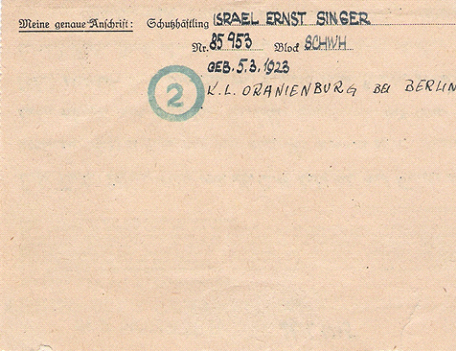
Early in 1945 the Allies broke through to Berlin and started bombing on a nightly basis, creating large craters in the streets. The Nazis gathered about thousand Jews and transferred them from Auschwitz to Sachsenhausen, where a subcamp named Schwarzweide was established. This subcamp was responsible for filling in the bomb craters left by the Allied air assaults in Berlin. Of those thousand prisoners, less than a dozen survived the war. We can identify mail from the Schwarzheide subcamp by the initials SCHWH in the return address.

Bergen-Belsen

The Bergen-Belsen concentration camp was set up originally as a special camp to house Jews to be traded for German nationals held abroad. This plan never came to fruition, and Bergen-Belsen was one of the first camps liberated by the Allied troops. Pictures of the emaciated men and women taken by Margaret Bourke White appeared on the cover of LIFE magazine.

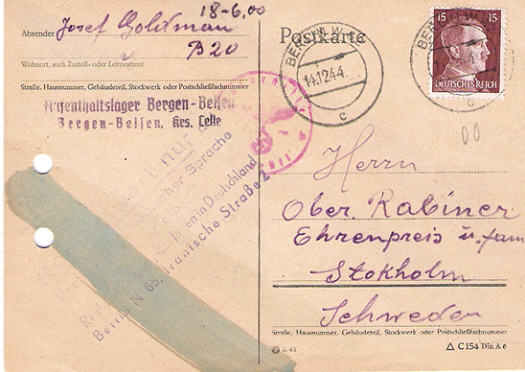
This cover was written at Bergen-Belsen concentration camp and transported to the Berlin Jewish Council. It was mailed through the postal system in Berlin on  December 14, 1944. The card was censored and checked for hidden messages using a blue chemical strip. It finally reached Rabbi Ehrenpreis in Stockholm, Sweden.


Back Next

Buchenwald

In the mid-eighteenth century, the town of Weimar was a seat of the German Enlightenment. It was home to some of the greatest German minds, including Goethe, Schiller, and Bach. However, Weimar also would become the site of Buchenwald, one of the largest concentration camps inside the 1937 German borders.

The camp, built to house opponents of the Nazi regime, was constructed by the prisoners themselves. After Kristallnacht and the beginning of the war, it became a major camp that incarcerated Polish and Soviet prisoners.

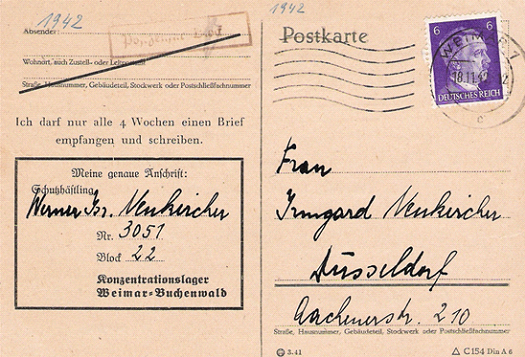
On this postcard, sent from the Buchenwald concentration camp, the Israel middle name identifies the sender as a Jewish inmate.  The card is dated November 11, 1942, and has brief preprinted instructions to the recipient, indicating that “I am only allowed to write and receive one letter every 4 weeks.”

Dachau

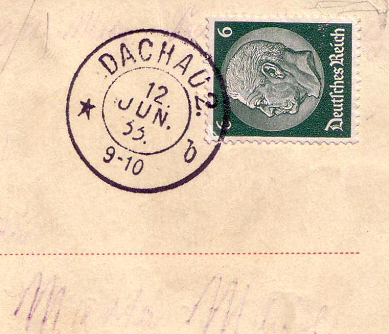
Hitler came to power on March 5, 1933, and the official opening of the first concentration camp was March 22, 1933: This was Dachau. This cover below is dated June 12, 1933, three months after the opening of Dachau opened.

A Personal Story

Many years ago I found an auction catalog containing 12 lots of postal cards from Dachau. The first listing was a postal card similar to this one, canceled March 22, 1933, the first day the camp was opened. We stamp collectors love to find a cancellation on the first day of an event, and the catalog description did not indicate it was a special date. I called the auctioneer, and before I even had a chance to explain, he said, “I know! You are the tenth person to call and tell me that I missed that March 22 is the opening of Dachau.”

He gave me information on the phone auction for the item, and I called in. The first time around, I bid $300.00; the second time, I had to calculate the cost of flying to New York, staying in a hotel, and dining, so I bid $1,100.00. The next time the bid came my way, it was close to $2,000.00, and I dropped out. The lot sold for over $2,000.00. I told this story in a presentation in 1986 at AMERIPEX, an international philatelic exposition. A gentleman in the audience raised his hand and said that he was the one who bought that cover.

Nuremberg Laws

Hitler changed the laws to nullify the degrees of Jewish professionals. Doctors, lawyers, and dentists could not pursue their respective careers, except with Jewish clients.

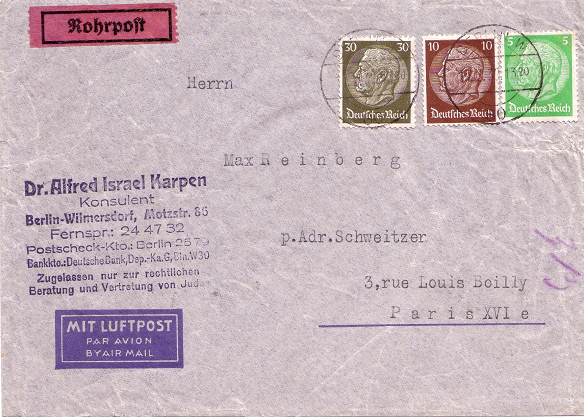
For example, this letter, sent from Dr. Alfred “Israel” Karpen, includes the text “Licensed solely for the legal counseling and representation of Jews” in the lines below the return address. Dr. Karpen could serve only as an advisor (Konsulent) to Jewish clients. (NOTE: The title doctor [Dr.] applied to lawyers in this era.) Even if a lawyer had many Aryan clients, he could not practice law on their behalf.

Sara and Israel Middle Names

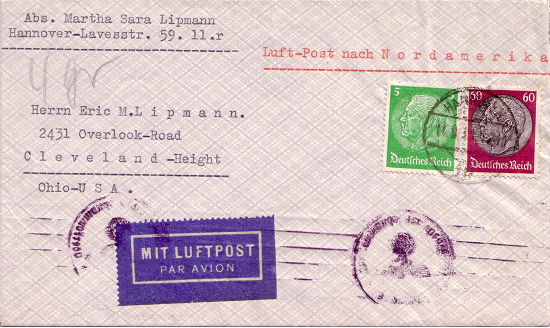
When Hitler was elected to power on March 22, 1933, he immediately started to change German laws to take things from the Jews, including citizenship, property, and professional degrees. On August 27, 1938, he finally gave the Jews something: He required the Jews to assume a middle name. All female Jews were to take the middle name of Sara, and all male Jews, Israel. This addition had to appear on all documents: passports, land titles, court papers, and so on. With regards to the postal system, this made it easier to identity Jewish mail for censorship.

This cover was sent air mail from Martha Sara Lipmann in Hannover, Germany, to Cleveland, Ohio, on September 11, 1939.