Der ewige Jude

Der ewige Jude was an exhibit featuring what the Nazis deemed to be “degenerate art” that traveled all over Germany and Austria. Depending how you translate the phrase der ewige Jude, it could mean “the wandering Jew” or “the eternal Jew.” Photographs featured in the exhibit identified typical “Jewish” features. The clothes they wore, facial and racial characteristics, religious items, and culture, were all shown in a very negative light. It also included so-called entartete Kunst (degenerate art) by Jewish and other sculptors and painters.
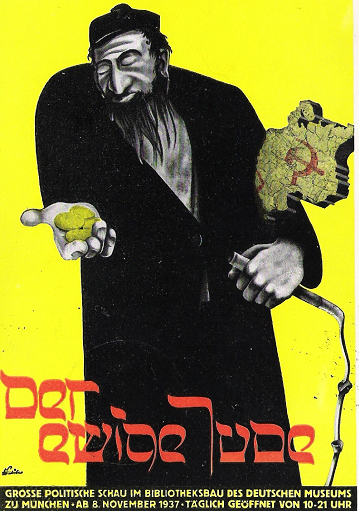
This postcard acted as an announcement of the opening of the exhibit and became the symbol for the show. It depicts a Jew with a hand out asking for money, we see the black coat (kaputa) and the sidelocks (payot) the traditional dress of the ultra-orthodox European Jew.The letters are in a Hebrew-like font in red to symbolize the blood libel, a slanderous myth related to Passover that was used to justify persecution of Jews starting in the Middle Ages. The map of Russia with the hammer and sickle links the Jews with Communism.
Anti-Semitism

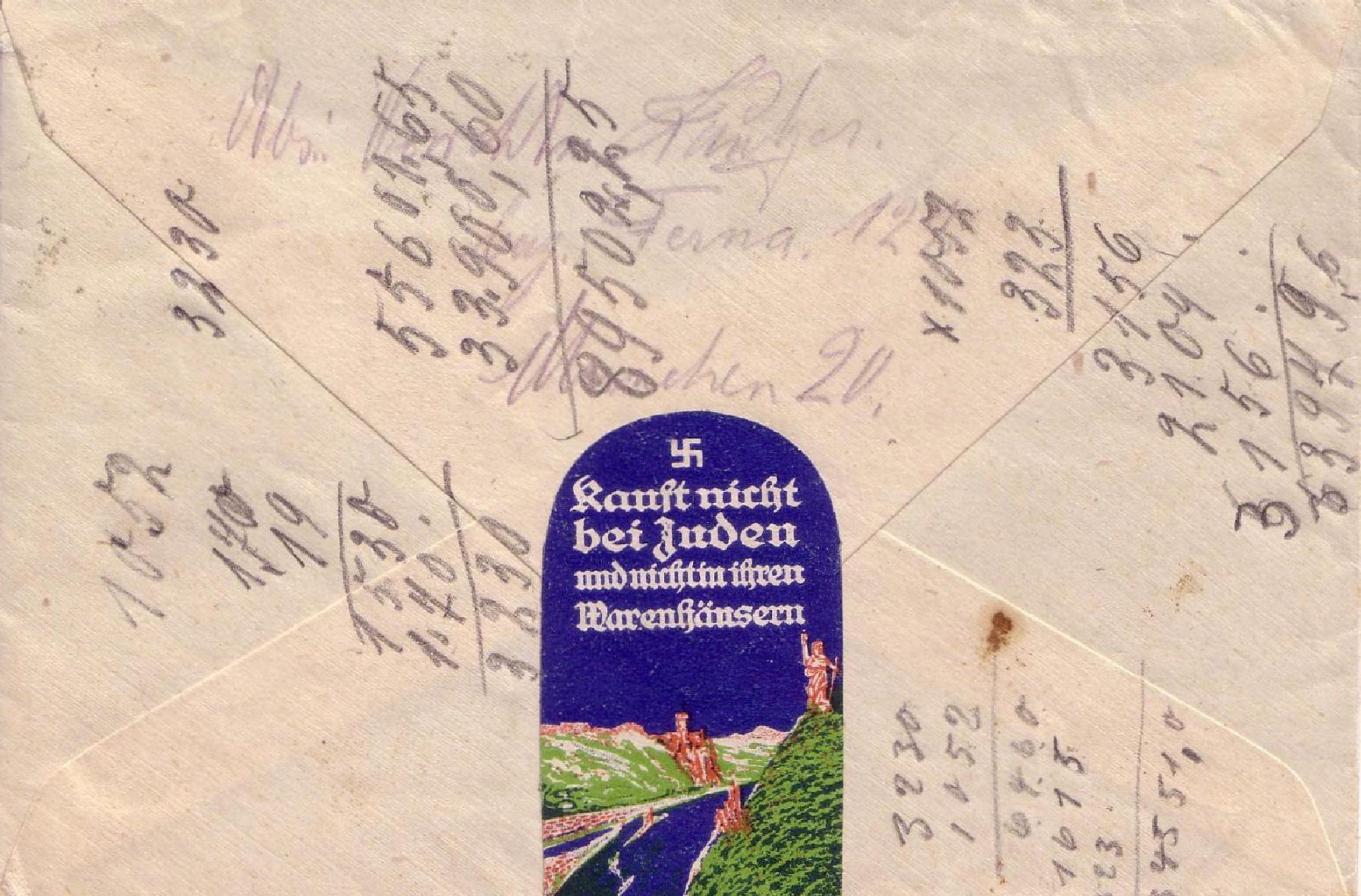
Hitler’s rise to power began with the fall of the Weimar Republic. There was rampant unemployment and great unrest in Germany. Hitler made speeches at beer halls, union party gatherings, and other events. One of his major themes was that Jews were the root of all evil and the cause of Germany’s problems. Anti-Semitism began to raise its ugly head and was manifested in many different forms: anti-Semitic literature, songs, and even labels placed on envelopes.

The back of this envelope, postmarked in the mid-1920s, bears an anti-Semitic label reading “Don’t buy from Jews or shop at their stores.”

Family Camp

At Auschwitz 2, or Birkenau, several distinctive camps were established. The family camp established by the Nazis was modeled after the Theresienstadt ghetto. It was supposed to be a model camp where the International Red Cross would visit and the see how well the Jews were treated under the Nazis. This never came to fruition.

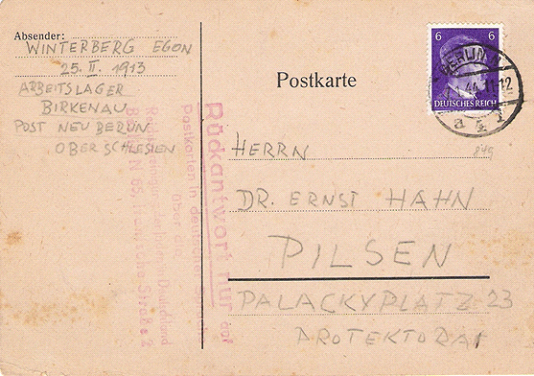
On September 8, 1943, the first residents of the Family Camps were transported to Auschwitz: 5000 Czechoslovakian Jews. They set up a model town with schools, a government, and postal system. The Nazis asked them to write post cards to their friends and relatives on March 9, 1944. The next day all the people in the family camp were gassed. The Nazis kept sending out these cards months after those who wrote them were killed. The Nazis parlance called this a Brief Aktion. Brief means “letter” and Aktion by Nazi definition is the German word for an “action” or campaign. When used by the SS or Gestapo, it often meant the roundup or murder of Jews.

This postcard was sent to Pislen, Czechoslovakia, with the return address Arbeitslager Birkenau, where the family camp was located. It was distributed through the Jewish Association in Berlin.

Politische Abteilung

A peculiarity existed in Birkenau: the Politische Abteilung, as the camp’s Gestapo office was called. This institution employed German-speaking Jewish women as secretaries. They enjoyed better living conditions than the other inmates because the SS saw to it that the inmates with whom they had daily contact had more hygienic surroundings. It is assumed that the SS preferred using Jewish women as secretaries because they were educated, had mastered several languages, and would never see freedom again, and thus would not be able to divulge any secrets.

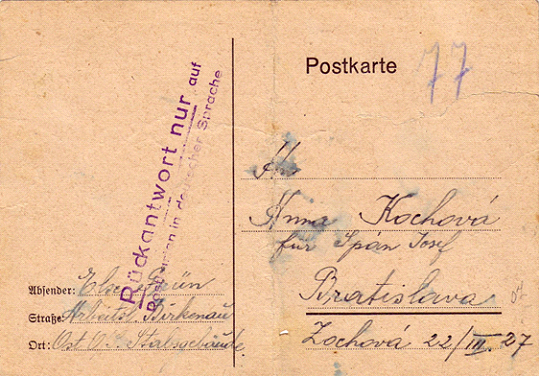
This postcard, sent from a secretary employed in Auschwitz’s Politische Abteilung. It was placed into special mail bag #77 originating from the camp. The card was not censored, other than receiving the handstamped admonishment to write in German.


Back Next