The End

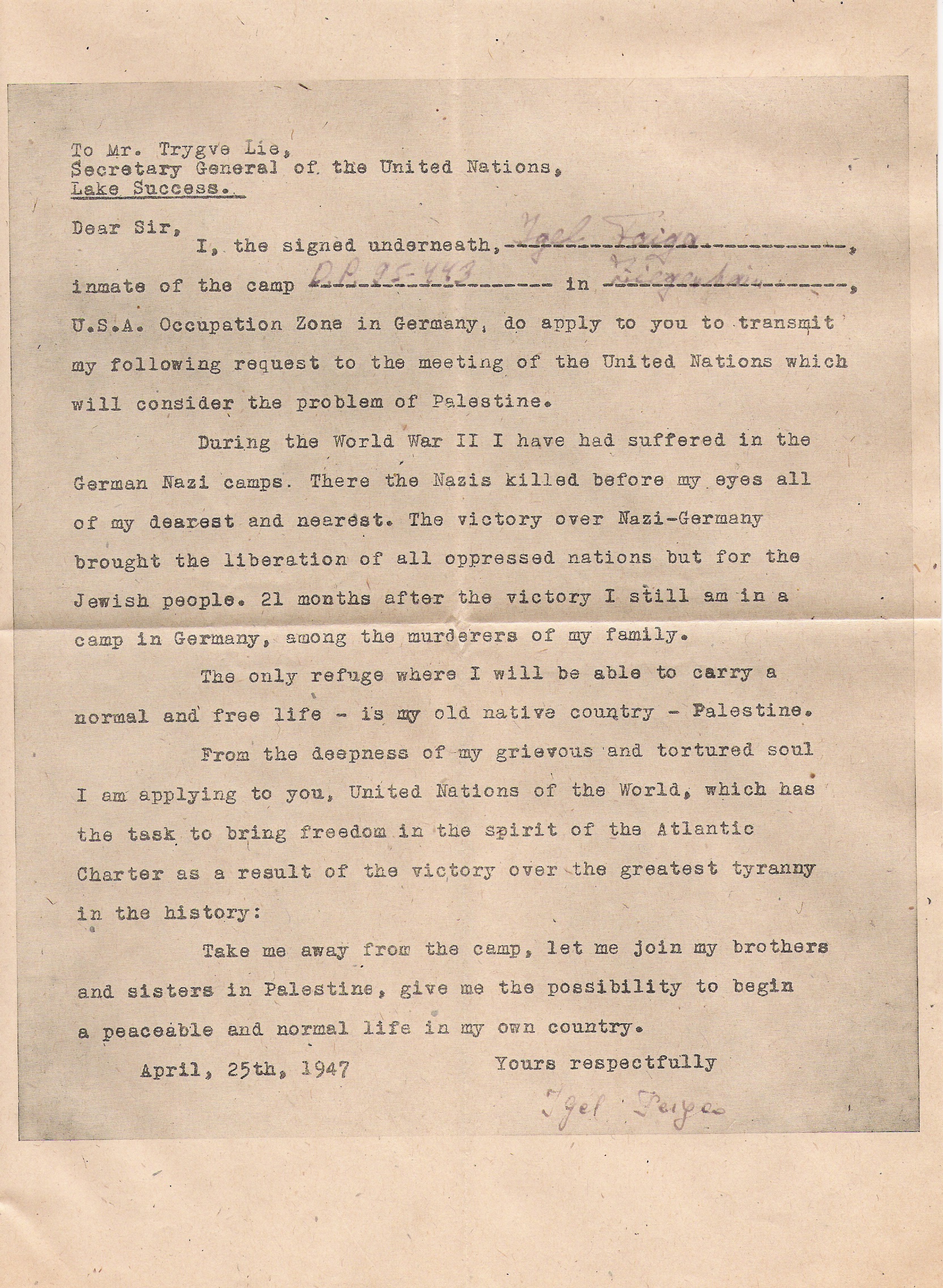
The war ended, and Europe was in a shambles. Despite the fact that the Jews were liberated by the Allied armies, they had no homes to return to and so were housed in displaced persons camps, operated by the United Nations, which were scattered through Europe. From the safety of the camps, the Jews of Europe began sending letters to the United Nations, requesting the establishment of a Jewish state.

This cover was from a displaced persons camp to Palestine.
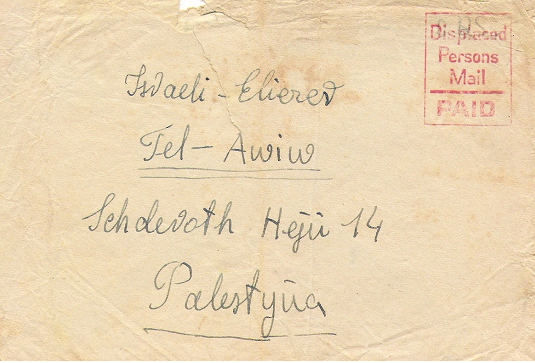
Contained in the cover was a letter, pictured below, addressed to Trygve Lie, Secretary-General of the UN. The letter requests that the homeless Jews scattered over Europe be given a nation to call their own.

Back

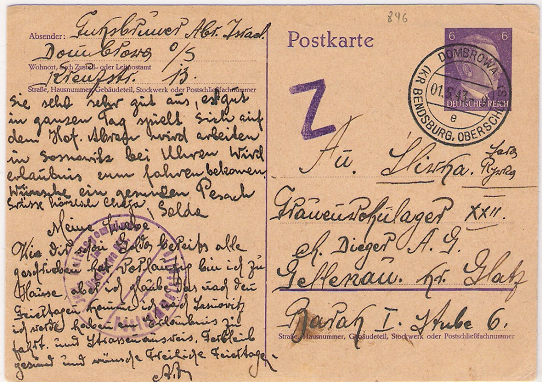
Dabrowa

The ghetto in Dabrowa in southern Poland was established in the poorest section of town in November 1939.  It remained an open ghetto until August 1942, when liquidation began.

I showed this postcard during my talk at AMREIPEX in Chicago 1986, and after the talk, a gentleman commented that he never heard from his family after he was sent to a camp at the age of 13. However, when he saw this postcard, he recognized that his sister had written it. The next day I brought the card and presented it to him as a gift.


Back Next

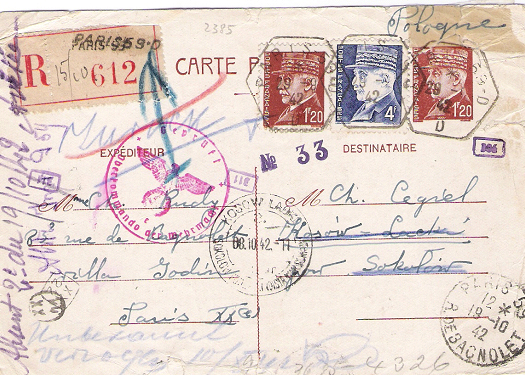
Sokolow Podlaski

In the second half of September 1939, a Red Army unit occupied the Polish town of Sokolow Podlaski, but after a week they with drew according to the Molotov-Ribentrop Pact. Many Jewish youngsters left town with the retreating Red Army. Soon after, the German Wehrmacht marched into town. On the first days of the German occupation Jewish males were kidnapped for slave labor and abuse.

An open ghetto was established in two streets around the main synagogue. Jews, newly evicted from their homes, were forced to move to those two streets. Traffic in and out of the ghetto was permitted, and the Jews could buy products from nearby Polish farmers.

However, the situation deteriorated. On the evening of Yom Kippur 5703 (10 October, 1942) the Sokolow Ghetto was liquidated. The Jews were herded to the market square and transported in sealed cattlecars directly to nearby Treblinka, where they were promptly exterminated upon arrival.

This postal card (with 2 extra stamps) has an angular September 29, 1942, date stamp to mark when it was sent from Paris. It was received in nearby Kosow Lacki on October 8, 1942 but was returned because by the time it arrived in Sokolow Podlaski, the ghetto had been liquidated.


Back Next

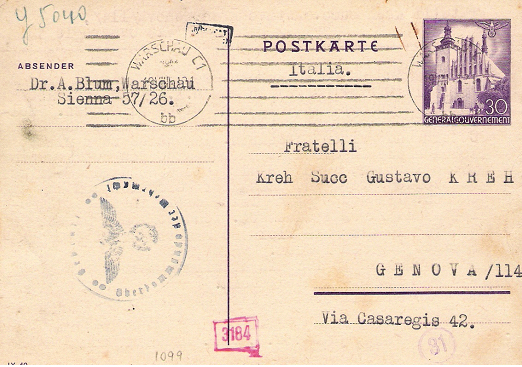
Kreh Brothers

The Kreh brothers were dry-goods wholesalers who ran a mail-order business out of Genoa, Italy. They sold religious items, etrogim (citron) and lulavim (palm fronds), for the Jewish holiday of Succoth. The etrogim grown in Genoa were considered the best in the world, and the brothers shipped them all over Europe, including to Poland. Because they could not send money internationally, many Polish Jews sent cards and letters to the brothers during the war, asking them to send the etrogim with promise of payment after the war. If the brothers sent the packages, they rarely got through.

This postal card was sent to the Kreh Brothers from Warsaw. It has a machine Warsaw C1 cancel dated March 10, 1942 and a small rectangular Judenrat Warschau (Warsaw Jewish Council) stamp.

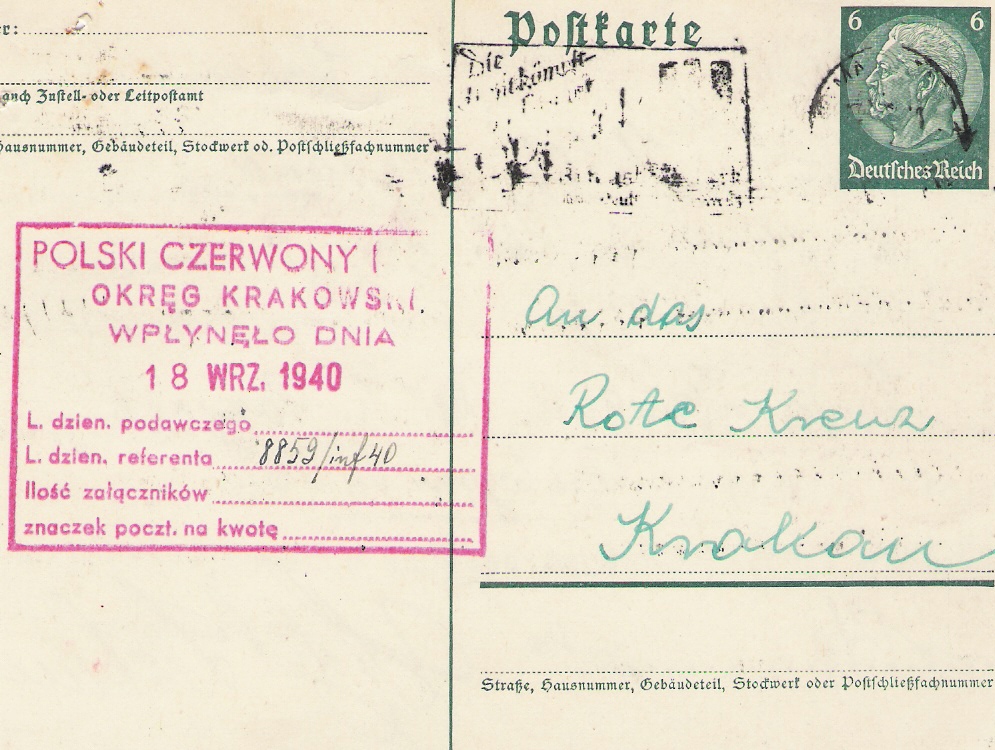
Polish Red Cross

This post inquiry card was mailed from Litzmannstadt to the Polish Red Cross in Cracow. It bears a circular date stamp of December 9, 1940, and an advertising cancel.

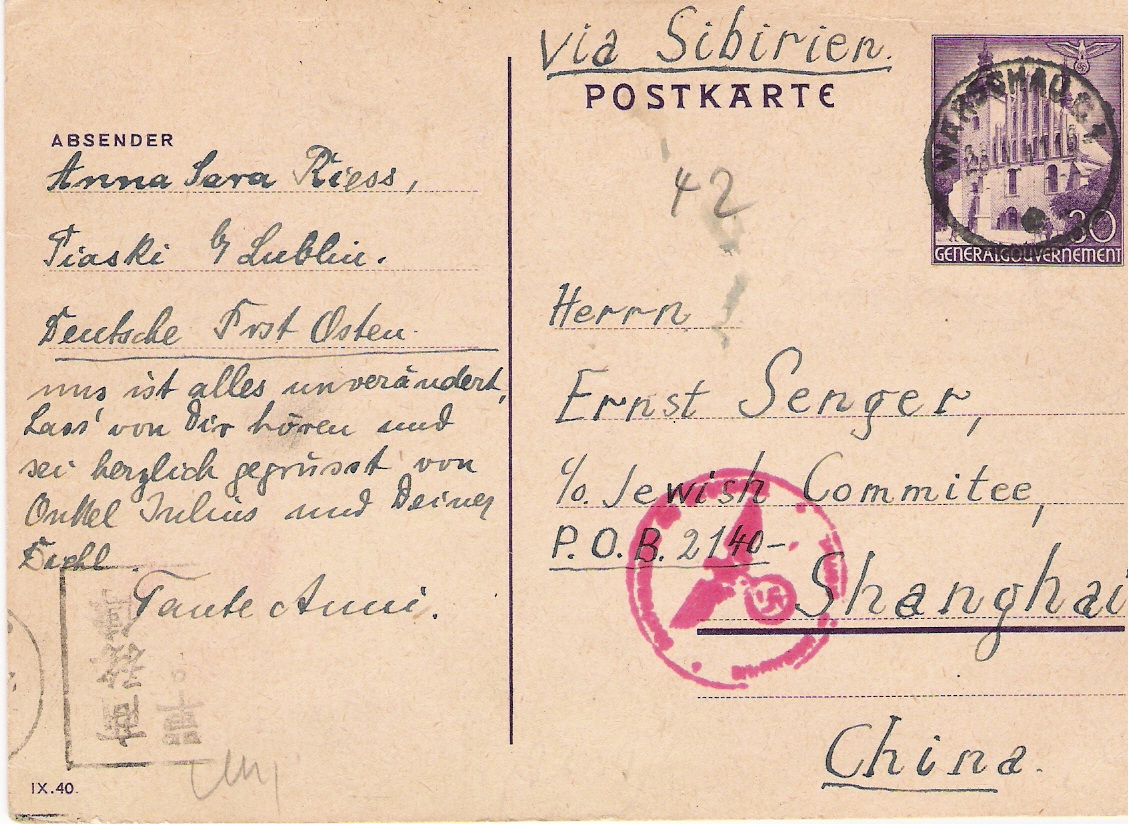
Piaski

In the Polish town of Piaski, the Nazi established an open ghetto in March 1940 with an associated work camp. Overcrowding was severe, with 20 people assigned to one room. The ghetto was liquidated in March 1943.

This postal card written has the return address of Anna “Sara” Riess, a German-Jewish woman who had been born in Piaski. When the invasion of Poland took place, all of the naturalized Jews were sent back to their birthplaces in Poland. While the card was written in Piaski, it was posted in Warsaw. It is possible that Riess had made her way there before mailing the card.


Back Next

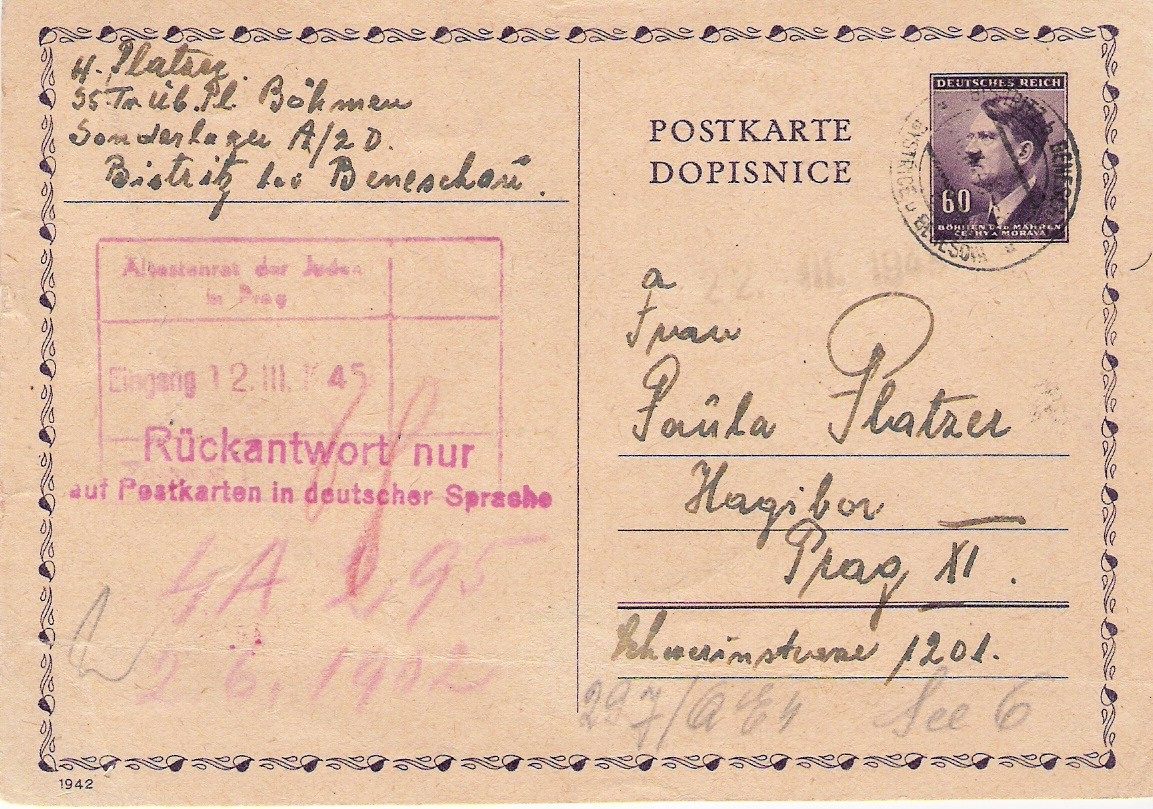
Hagibor

One of the very first covers I obtained in the area of the Holocaust is picture below. It intrigued me because it had the Hebrew word Hagibor, meaning “strength” in the address. At a stamp club meeting I showed this cover, and a gentlemen in the audience explained that Hagibor was a soccer camp for Jewish youth from all over Europe and was located outside of Prague. I could not figure out what this had to do with the Holocaust. So I went to Spertus College Library to research this, and I found an article that indicated that Hagibor was a special camp (Sonderlager) for spouses of mixed marriages.

The article also stated that mail from the Hagibor Camp is generally written on postcards, and the messages consist of no more than 32 words. The censor numbered each word and placed his initials on the card.

This postal card was sent to Hagibor and has a circular date stamp of March 4, 1945.  The markings indicate that the card should be written in German, and there is also a marking from the Prague Jewish Council.

Warsaw

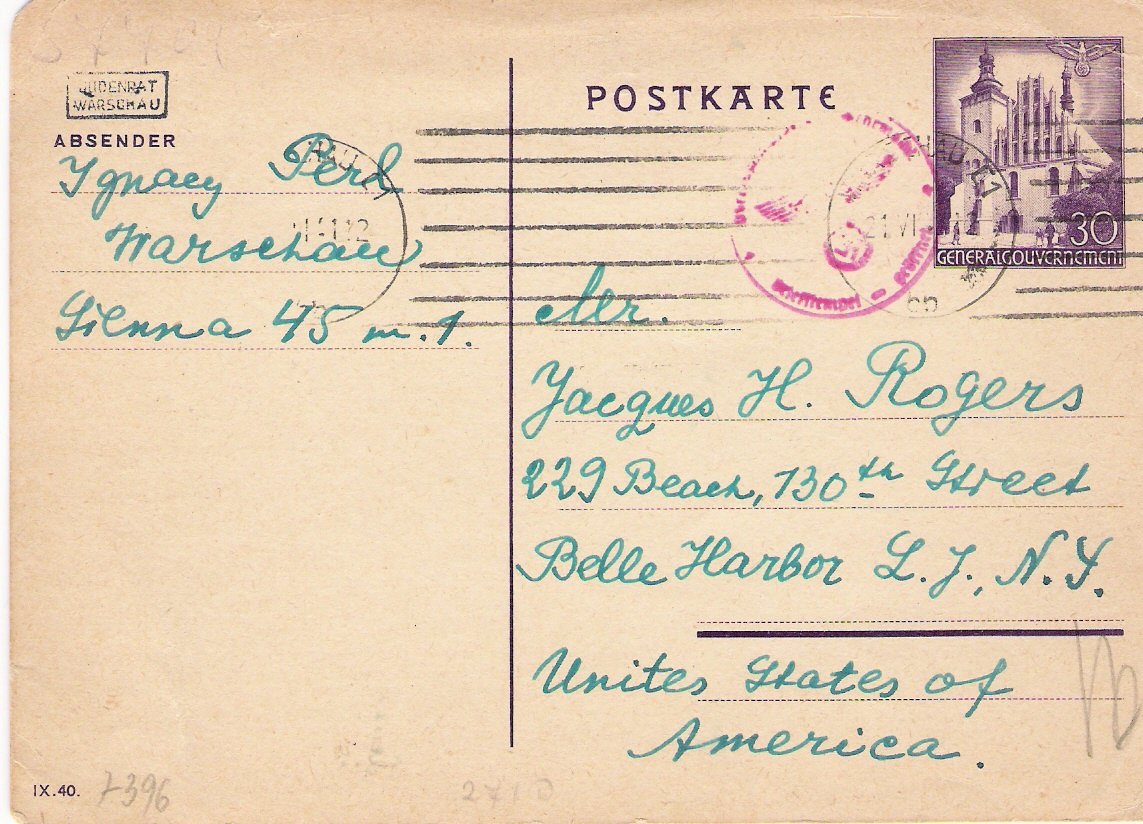
Warsaw, the capital of Poland, was one of the first cities occupied by the Nazis. The Jews were forced to move into the poor area of town, which was sealed off and connected to the city by only a bridge. This ghetto became the largest in the General Government, containing almost a half million people. When the Nazis started to liquidate the ghetto, the Jews revolted, and the resulting Warsaw Rebellion ultimately led to the complete and utter destruction of the ghetto.

This postal card, sent from the Warsaw ghetto, has a machine Warsaw, June 21, 1942, cancel to Belle Harbor, NY. It was censored by the Nazis, as shown by the circular red handstamp. The small rectangular box in the left corner is the ghetto postal censor.

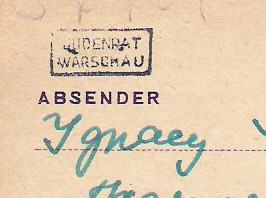
This is the handstamp of the Warsaw ghetto. It reads Judenrat Waschau (Warsaw Jewish Council).

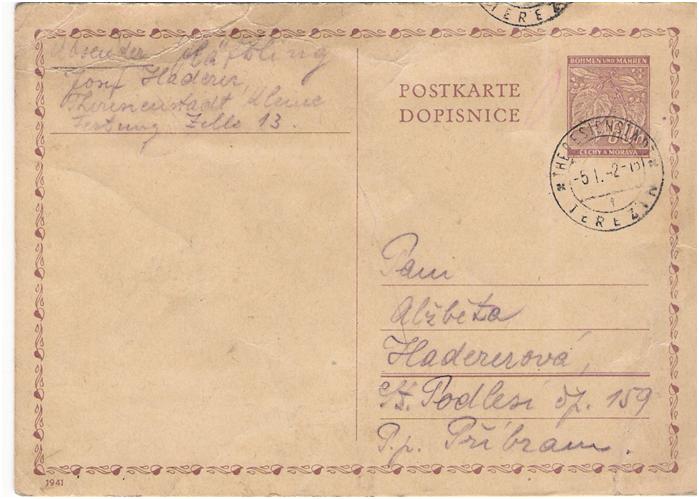
Kleine Festung

The Kleine Festung or “Little Fortress” was a prison in Theresienstadt and contained all the non-Jewish prisoners. Ironically, mail from the Kleine Festung received the Theresienstadt cancellation, by mail from the ghetto did not.

This postcard that was mailed from the Kleine Festung has a circular Theresienstadt cancel dated January 5, 1942. The third line in the return address indicates that the card is from the Kleine Festung.

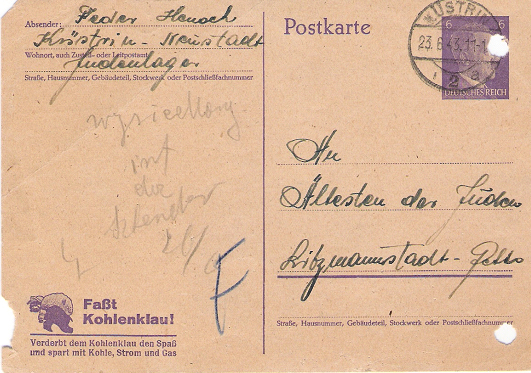
Küstrin

Küstrin was a Judenlager (Jewish work camp) located near the town of the same name. Prisoners processed wool, which was used to fabricate military uniforms. The camp opened in January 1943 and was liquidated by the end of 1943.

This postcard was sent from Küstrin camp, which is indicated in the third line down in the return address by the word Judenlager. The card was postmarked June 23, 1943.


Back Next